

The independent verifier for trading strategies written by AI agents and humans.
Catch look-ahead bias, hidden trading costs and overfitting before a backtest reaches your money.













Docs · Quick start · Use from agents · Verifier API · Trap Suite · Changelog
Did it catch a leak in your backtest? Star the repository so other quants and agent builders can find it, or tell us what it missed.
60 seconds to your first REJECT
pip install monte-neo
monte-neo verify --demo
No files needed. Two strategies run on synthetic prices: one peeks at tomorrow's close and is rejected, the other does not and is judged on its merits. Then try your own:
monte-neo verify --ohlcv data.csv --strategy my_strategy.py --n-trials 20 --out cert.json
monte-neo repair --explain cert.json     # what each finding means and what to do
Where to go next:
- Your kind of strategy: profiles for trend, mean reversion, pairs, carry, long-short, allocation, short volatility, event-driven and options.
- How ready is the evidence: the Alpha Readiness Level (ARL 1 to 9 and depth 0 to 4), devised by Rostyslav Shcherbyna, author of Monte-Neo; provisional rules.
- Search without fooling yourself:
monte-neo research. - See what was verified, and what failed: the Hall of Fame and the catalog results.
- Limits: what is not covered. Not investment advice.
The problem
A coding agent can turn a trading idea into a backtest in minutes. It will then tell you the strategy returns 40% a year with a Sharpe of 3. Most of the time that number is wrong, for the same few reasons:
- Look-ahead bias. The code reads future bars:
shift(-1), centred windows,bfill, statistics over the whole series,np.gradient, an FFT filter. - Missing costs. The edge is smaller than fees and slippage, or it disappears when the fill comes one bar later.
- Selection bias. The agent tried 300 variants and reports the best one as if it were the only one.
Backtest libraries run whatever code you give them. None of them tell you the backtest itself is broken.
The solution
Monte-Neo checks the backtest, not the idea. Give it the price data and the strategy code or its positions. It returns one of four verdicts, the checks behind the verdict, concrete next steps and a reproducible, optionally signed certificate.
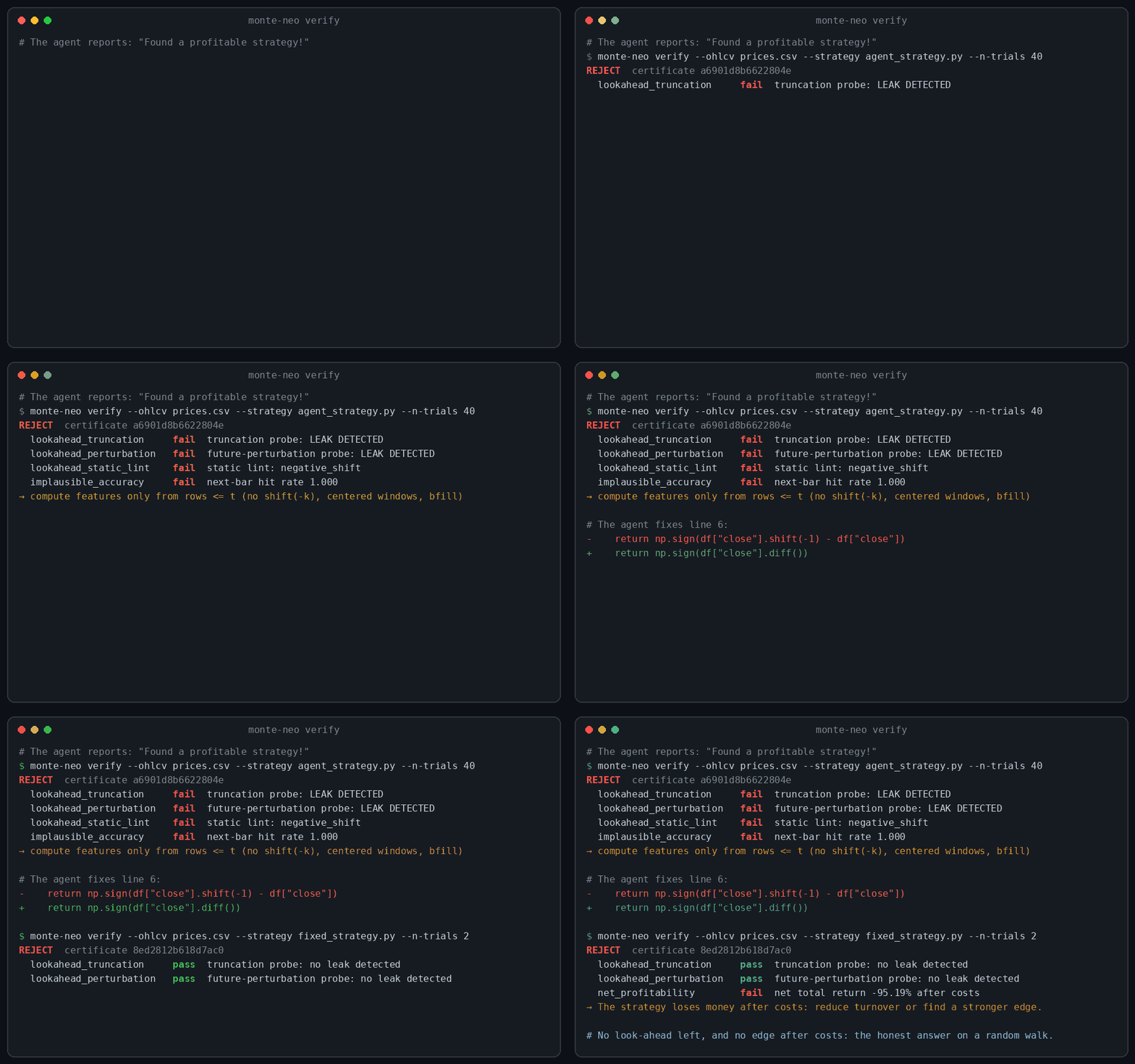
The agent's strategy used shift(-1), so it knew the next close. Monte-Neo found the leak in four
independent ways and named the line. After the fix, no look-ahead is left, and the verifier tells
the truth: on a random walk, the strategy has no edge after costs.
The same run as a report for people (--html report.html: one file, no scripts, no network):
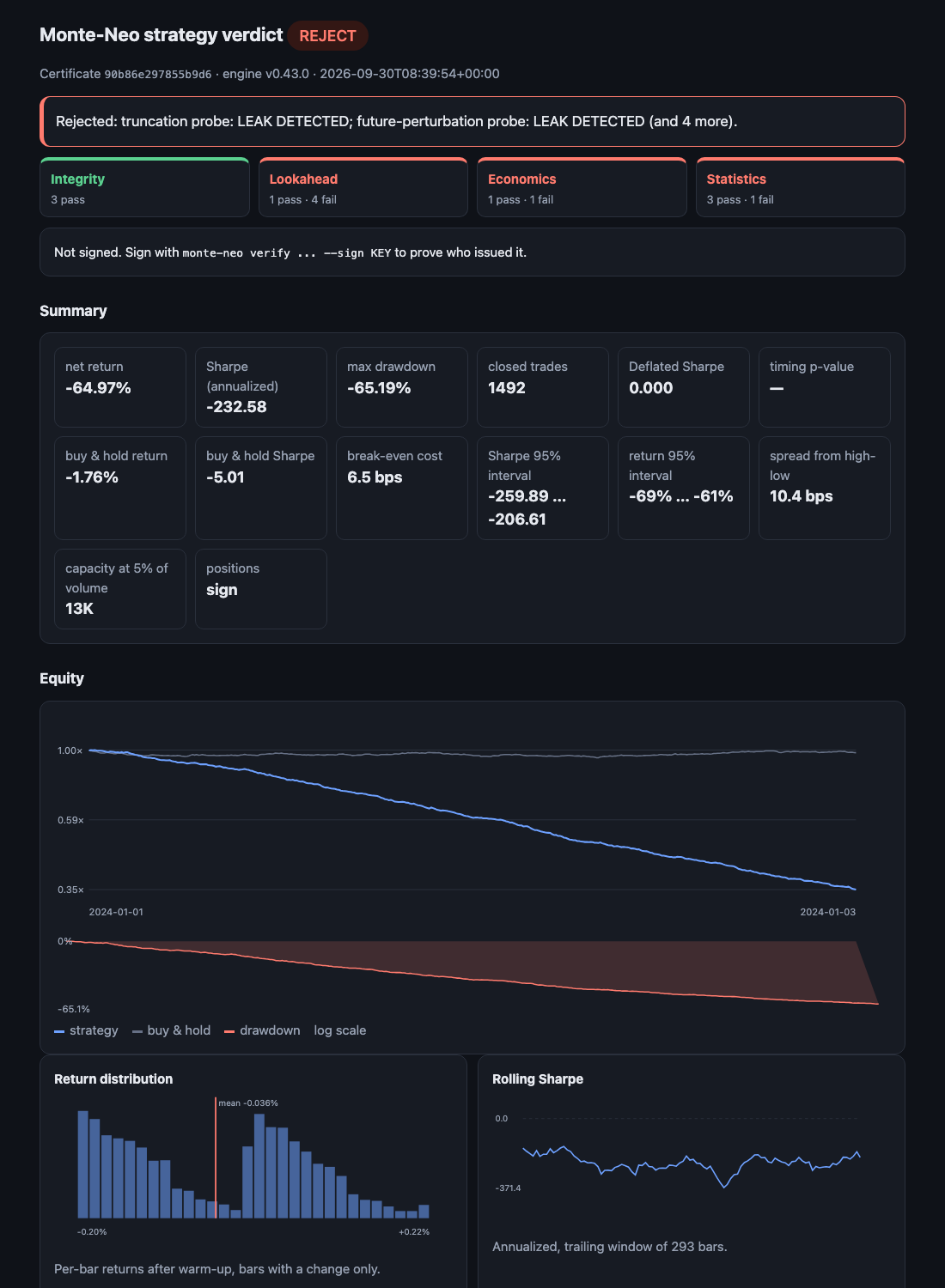
More reports, including an honest strategy and a parameter search, are in the gallery.
Text output of the first run
$ monte-neo verify --ohlcv prices.csv --strategy agent_strategy.py --n-trials 40
REJECT  certificate 7f0603b0e604bea5
  check                    category    status  summary
  data_integrity           integrity   pass    OHLCV is clean
  lookahead_truncation     lookahead   fail    truncation probe: LEAK DETECTED
  lookahead_perturbation   lookahead   fail    future-perturbation probe: LEAK DETECTED
  lookahead_static_lint    lookahead   fail    static lint: negative_shift
  implausible_accuracy     lookahead   fail    next-bar hit rate 1.000 over 2999 bars (z 54.8)
  net_profitability        economics   fail    net total return -64.97% after costs
  deflated_sharpe          statistics  fail    deflated Sharpe 0.000 over 40 trial(s)
  ...                                          (16 more checks)
→ The signal at bar t changes when later bars are removed: compute features only from rows <= t
  (no shift(-k), centered windows, bfill or full-sample stats).
→ Fix the flagged source lines (negative shift, center=True, backward fill) and re-run verify. Lines: 6.
The run used a synthetic random walk; output shortened.
| Verdict | Meaning | CLI exit code |
|---|---|---|
PASS | No problems found | 0 |
PASS_WITH_WARNINGS | Usable; read the warnings | 0 |
NEEDS_MORE_EVIDENCE | Too few trades, or the Sharpe does not survive the number of variants tried | 1 |
REJECT | The backtest is broken or loses money after costs | 2 |
New in v0.55: a profile for every strategy type, and a readiness scale
- Strategy-type profiles (
verify --profile ID,--list-profiles): trend and CTA, mean reversion, pairs and stat-arb, carry, cross-sectional long-short, buy and hold, allocation and risk parity, market neutral, short volatility, event-driven and options. Each profile names the checks that type needs, its benchmark, its traps and what is not assessed. A profile adds coverage; it never raises a verdict. Guide - Options verification (
verify --options FILE): fills against bid and ask (no fantasy mid fill), volatility seen after the decision, Black-Scholes tail stress, early exercise, pin risk and margin. Guide - Alpha Readiness Level with depth (
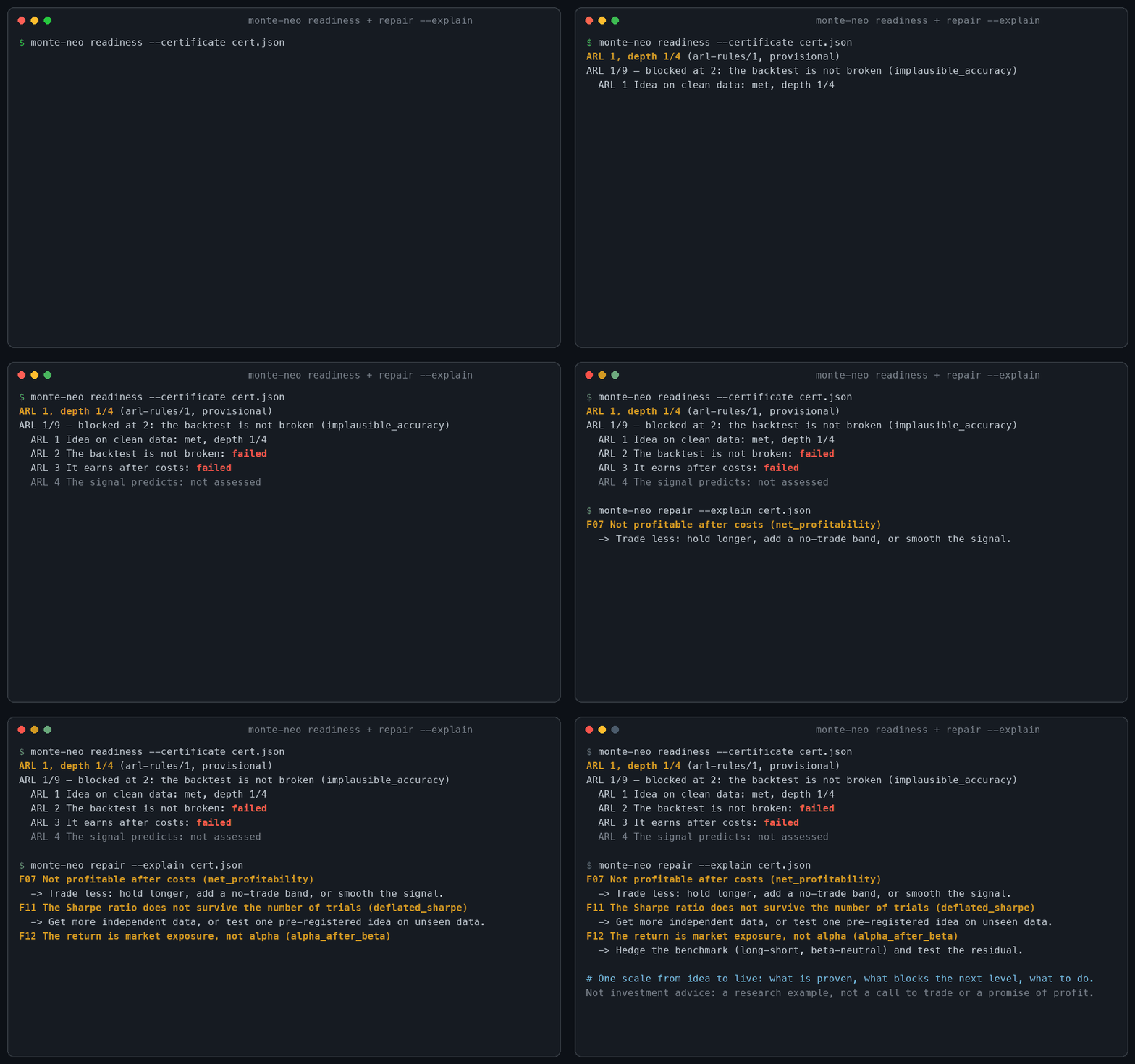
monte-neo readiness): nine levels from "idea on clean data" to "live with real fills", each with a depth of 0 to 4, read from one versioned rules file. Guide - Detect, explain, repair:
repair --explain CERTexplains 16 common findings in plain words with the next action;repair --previewshows a fix before and after, and every preview counts as a trial. Guide - Honest strategy search (
monte-neo research): discovery, pre-registered validation, family-wise tests, one sealed holdout opened once. Guide - Extended dossier for a committee, a delta-neutral carry path, a strategy catalog of 100 strategies, a
Hall of Fame ranked by evidence, and econometric checks for pairs (
verify --legs --pairs-checks). - Windows: command lines with Windows paths, journals and certificates now behave the same on Windows, macOS and Linux; CI runs every supported Python (3.11 to 3.15) on all three systems (Windows on 3.15 waits for a regular NumPy build).
All changes: changelog.
New in v0.54: phantom profit in pairs strategies
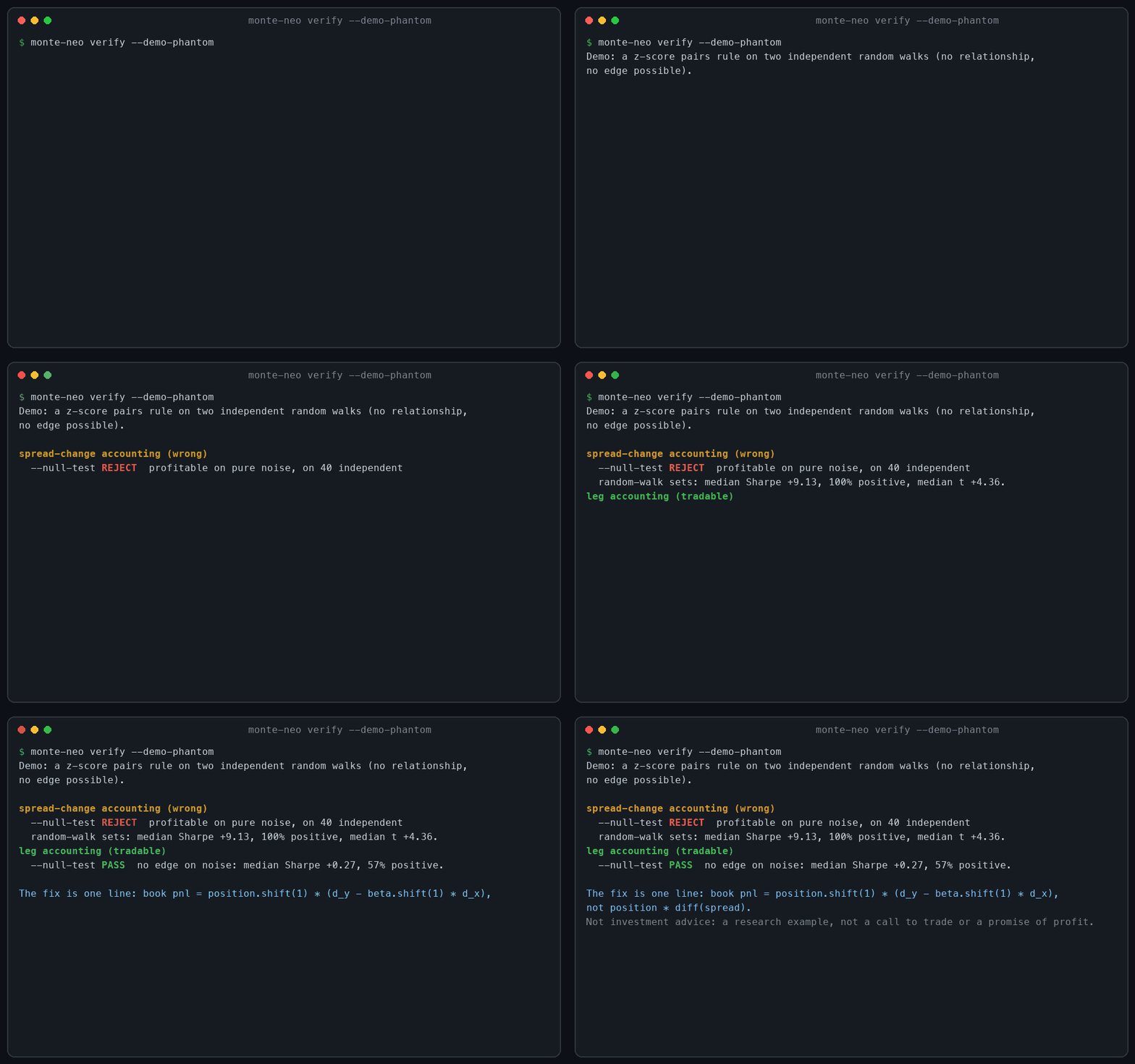
A pairs rule booked as position * diff(spread) earns on two unrelated random walks. verify --legs re-derives the
profit from the legs you could trade, verify --null-test runs your rule unchanged on independent random walks, and
verify --demo-phantom shows both in one command. Guide
Since v0.53: from a rejected backtest to a committee
Repair the strategy, without overfitting it
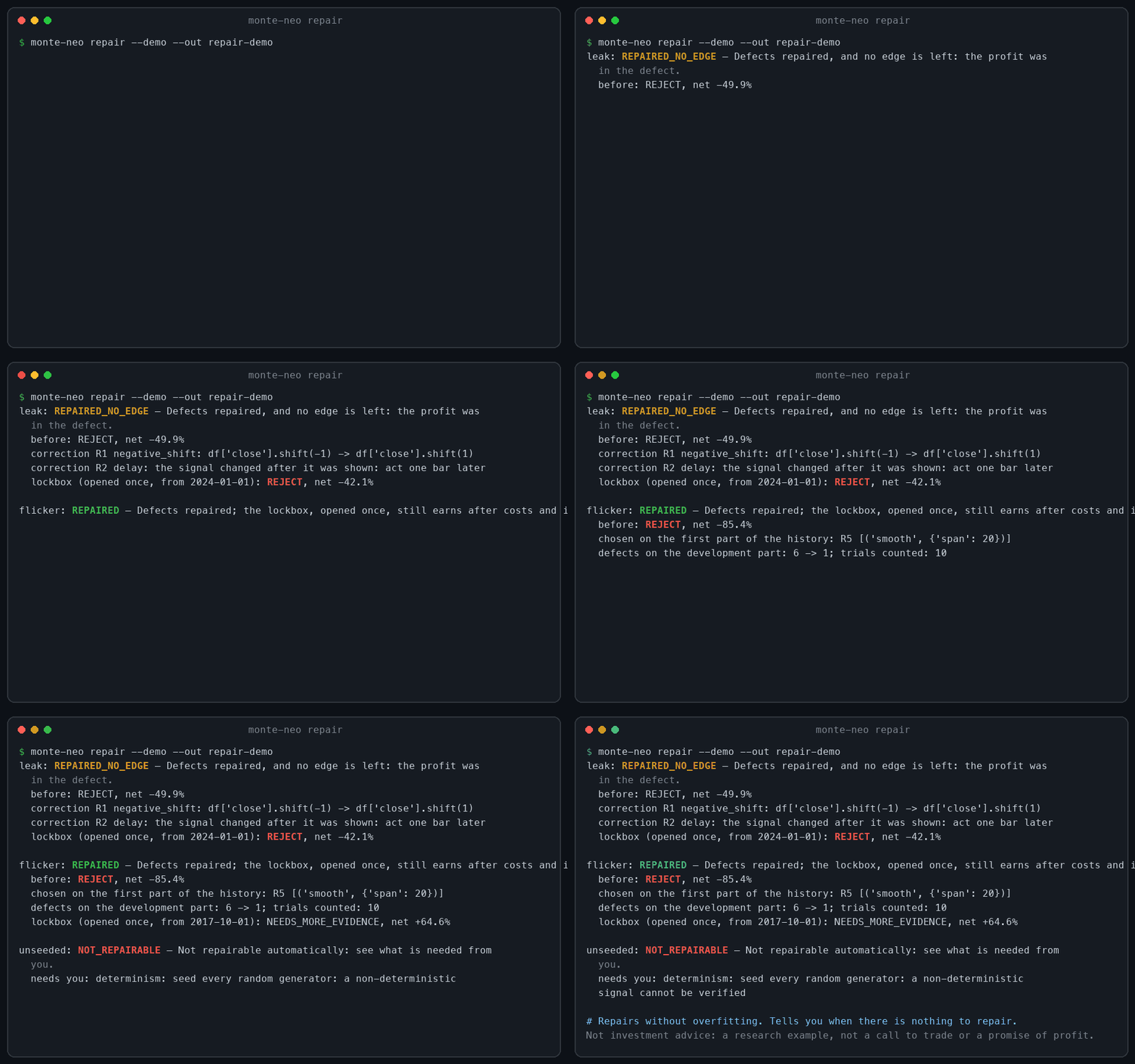
monte-neo repair --demo
monte-neo repair --ohlcv data.csv --strategy my_strategy.py --out repair/
Optimisers maximise the return, so they overfit. repair minimises defects instead. It first corrects
look-ahead and repainting. Then it picks from a short list of declared repairs (smoothing, holding period,
no-trade band, tranches, neutralisation, caps, volatility target) on the first 70 % of the history, by the number of
defects left and never by return, and counts every candidate as a trial. The last 30 % is a lockbox, opened once.
There are four outcomes:
REPAIRED: on data the choice never saw, the strategy still earns after costs and is not rejected (the lockbox can still ask for more evidence, such as more trades).REPAIRED_NO_EDGE: the defects are gone and so is the profit, because the profit was in the defect.NOT_REPAIRABLE: what you have to do yourself.NOTHING_TO_REPAIR: there was nothing in the catalogue to fix.
The original file is never touched. On a random walk, none of the 68 leaking strategies of the Trap Suite comes out
as REPAIRED. Guide.
Is it alpha? An Alpha Readiness Level for the committee
monte-neo alpha --demo --aum 2e5
monte-neo alpha --ohlcv universe.csv --scores scores.csv --aum 5e7 --book book.csv --n-trials 40
A ranking signal gets the checks a fund's research committee runs before it gives capital:
- signal power: rank IC, decay, quantiles, placebo scores;
- attribution: is it alpha, or momentum and short volatility under a new name?
- value to your book: the marginal Sharpe;
- implementability: square-root impact at your capital, capacity, short leg, rebalance day;
- robustness: subsets, start dates, bootstrapped markets;
- data and process: today's index members, mismatched exchange closes, decay after publication;
- multiple testing: the t ≥ 3 hurdle, the minimum backtest length;
- risk: named crises, tails.
Everything ends in one line, for example ARL 6, depth 3/4 (arl-rules/1, provisional) and
ARL 6/9 — blocked at 7: tradable and robust (rebalance_timing_luck).
Missing evidence is "not assessed", never passed. Guide, ARL rules.
The Alpha Readiness Level (ARL) was devised by Rostyslav Shcherbyna, author of Monte-Neo; it is modelled on the idea of a technology readiness level and is a Monte-Neo scale, not an industry standard.
Evidence a model-risk committee can file
monte-neo dossier --certificate cert.json --framework sr11-7 --name "Momentum 20" --owner "Desk A"
monte-neo monitor --certificate cert.json --live live.csv        # after launch: is the alpha dead?
A validation dossier is one folder with:
- one printable page: summary, checks, readiness level, assumptions and limitations, how to reproduce, sign-off fields;
- a clause map to SR 11-7, PRA SS1/23, MiFID II RTS 6, a crypto checklist or an academic appendix;
- the certificate and the environment.
The map shows evidence, never compliance. monitor compares live returns with the backtest, measures realised
slippage and raises sequential alarms when the edge dies.
Guide.
Machine learning, LLM signals, events and track records
fit/predict. Definefit(train)andpredict(model, df)instead ofsignal(df). The verifier refits only on the past, andml_refit_gaprejects a model whose profit lived in fitting on the whole file.--model-cutoff 2024-06. An edge that exists only before a language model's training cutoff is look-ahead through the model's memory.--events events.csv. News, earnings or LLM outputs are joined by publication time. The report shows what a join by event time would have earned.verify --returns manager.csv. Due diligence from returns alone: smoothing, missing small losses, implausible consistency, significance given the manager's number of funds.verify --legs legs.csvand--null-test pairs.py:pnl. Phantom profit in pairs and stat-arb strategies: a rolling hedge ratio booked as position times the change of the spread earns a profit that no trader could, even on independent random walks.--legsre-derives the P&L from the quantity held in each leg and rejects a reported return the legs never earned (and writes the corrected series);--null-testruns the strategy on random walks, where it must earn nothing. Trymonte-neo verify --demo-phantom.- Your institution's rules and history.
--policy policy.tomlapplies your thresholds and records them in the certificate.--trials-from mlflow:./mlruns(Optuna, W&B, Ray Tune too) counts the runs you already logged.--ledgeron a shared drive counts the whole team's attempts. - Where you already work.
%%verifyin Jupyter, Polars frames as input, andmonte-neo dossier --litefor a one-page plain-language summary for people who do not read Sharpe ratios. - Two more lint rules for ML code.
full_sample_transform(a scaler or PCA fitted on all rows) andtarget_encoding_full(a target mean over all rows mapped back to features).
Guides: ML and events · track records · phantom profit in pairs strategies · policy, trials, model cutoff · reference alpha.
Catch look-ahead that hides in milliseconds
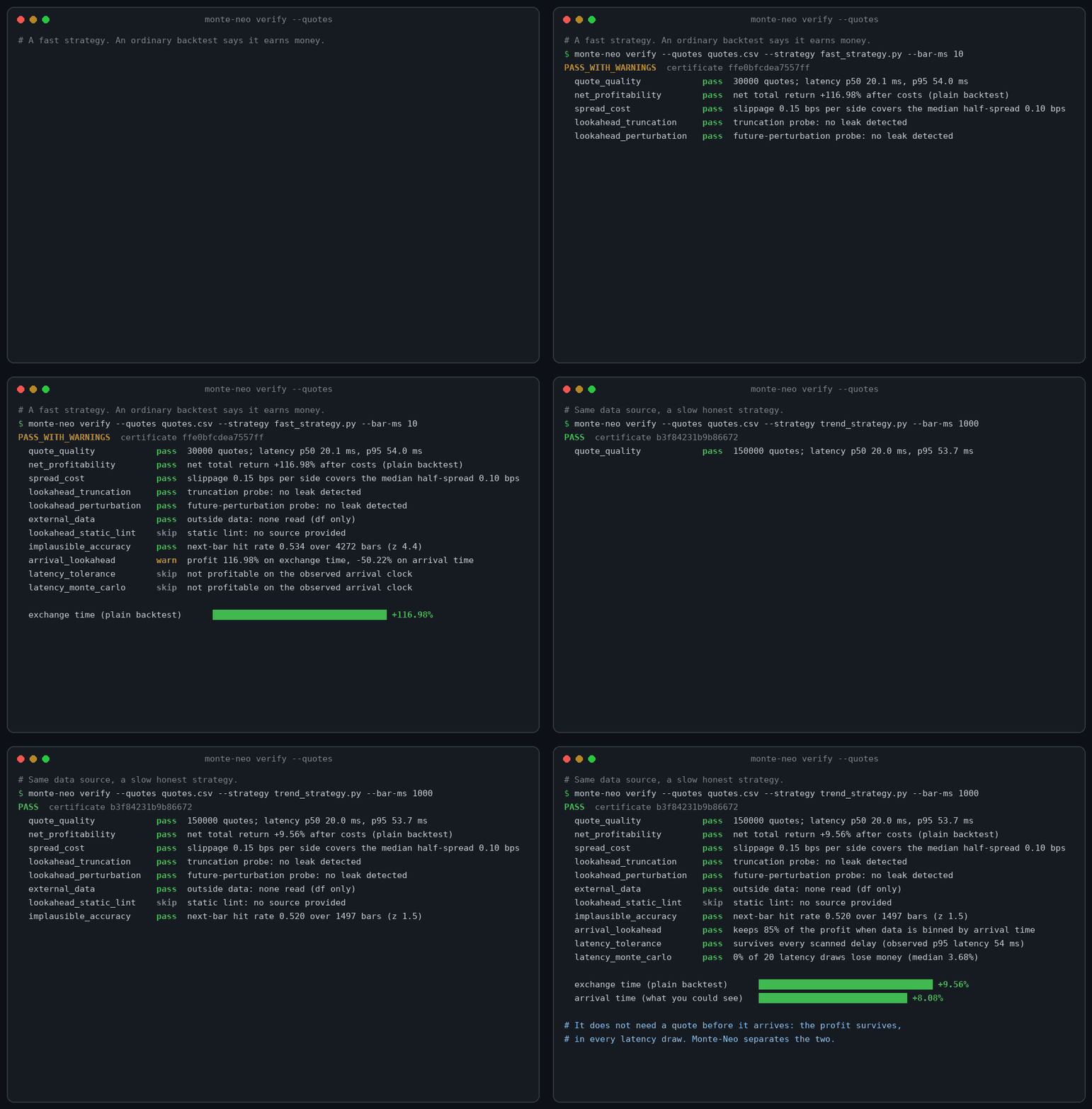
The problem. A quote has two times: when the exchange stamped it and when it reached you. Most backtests on intraday quotes bin them by the stamp, so a fast strategy trades on prices it could not have seen yet. No code lint finds this: the leak is in the clock, not in the code.
What Monte-Neo does (monte-neo verify --quotes quotes.csv --strategy my_strategy.py):
- Arrival look-ahead. The same strategy sees bars built from the arrival time and trades against the market. If the profit exists only with zero latency, it is a leak at millisecond scale.
- The delay where the profit vanishes. One number you can act on: "the profit disappears at 38 ms of extra delay".
- Latency Monte Carlo. Each quote's latency is redrawn from the latency you actually observed (inside its venue), 200 seeded draws: the distribution of the return and the probability of a loss. It shows when a profit was lucky latency.
- Order delay.
--order-latency-msdelays every fill, so an edge that lives in instant execution is rejected. - No server near the exchange?
--latency-model lognormal:8,25assumes the latency (median and p95 in ms) instead of reading it, and the certificate says plainly that it is assumed, not measured. - Several feeds in one strategy.
--symboland--feedslet a strategy trade one instrument on the prices of another (lead-lag, futures against spot); each feed has its own latency. A leader that arrives after the follower moved is caught. - Look-ahead probes too. The truncation and perturbation probes of
verify_strategyrun on the arrival bars, so a strategy that reads the next bar (shift(-1)) is rejected: that leak exists on every clock. - Quote quality. Crossed quotes, negative latency, out-of-order arrivals and bursty latency: a congested path (VPN, Wi-Fi) holds messages and releases them in bursts, and the check says so instead of reporting your network as a result.
- A certificate. Signed, and reproducible with
--rechecklike every other certificate.
$ monte-neo verify --demo-quotes     # no files: a fast strategy and an honest one
$ python -m monte_neo.data.quote_recorder --symbol BTCUSDT --seconds 600 --out quotes.csv   # your own latency
What sets it apart: it is an audit, not an environment. It takes a finished strategy from any source (any signal(df)
function, or an agent's code) and your own quote recording, and says whether the profit survives the time the data
arrived, with a certificate others can reproduce. The strategy does not have to be written for a particular engine.
Honest scope: experimental. The latency checks are context (warn at most) and were calibrated on synthetic data, so record
real latency on the machine that will trade, or state an assumed latency and read the verdict as conditional on it. Fills
are taker orders at the mid, with the data latency from the quotes (or assumed) plus a fixed order delay. Queue position and
partial fills are not modelled, on purpose (they need the order book and a passive-order model; a rough formula would give
false precision), so a market-making strategy cannot be validated here; the certificate lists these assumptions.
Read the guide.
Search for an indicator, honestly
monte-neo discover --ohlcv data.csv --out found/
Tries thousands of causal formulas, counts the search, tests it against shuffled markets and a lockbox, and writes a certificate for the winner. On random walks it names nothing (0 of 60 searches in the calibration), although a plain search would report a Sharpe above 6. See the guide.
The rest of the workflow
verify --ledgercounts every variant you try;verify --suggest-fixrewrites leaks as a diff (guide).- Signals must not repaint: a signal that changes after it was shown fails, and a signal that needs the bar's own prices is reported (guide).
history,register,oracle,portfolio,doctor: certificate history with a regression exit code, pre-registered hypotheses, a Thresholdout hold-out for agents, many strategies at once, and known problems of data exports (guide).- The honesty scorecard shows how often the verifier catches leaks and spares honest strategies (hypothesis zoo, with intervals and known gaps).
What it checks
| Family | Checks |
|---|---|
| Look-ahead | Truncation probe (does bar t change when later bars are removed?), future-perturbation probe, outside-data watch (files or network read by the strategy), static AST lint (23 rules), implausible hit rate |
| Economics | Net return after commission and slippage (with optional funding, short-borrow fees, stops inside the bar and per-symbol costs for universes), break-even cost in bps, one- and two-bar execution delay, a spread estimate from high and low next to the modeled cost, capacity from volume (for universes with the tightest symbols named) |
| Statistics | Probabilistic and Deflated Sharpe priced by n_trials, Monte Carlo timing test (does the signal beat shifted copies of itself, or just ride the market?), sample size, holdout consistency, bootstrap confidence intervals, the minimum track record length and the result of each of six equal windows; for grid searches, walk-forward out-of-sample, parameter-plateau, probability-of-backtest-overfitting (PBO) and Reality Check / SPA checks |
| Integrity | Broken OHLCV (NaN, bad prices, bars out of time order), bad data that makes fake profit (one-bar spikes, frozen prices, unadjusted splits, gaps in time), non-deterministic signals, survivorship bias in a universe |
| Latency (quotes) | Arrival look-ahead (profit on exchange time against arrival time), the delay in ms where the profit vanishes, a Monte Carlo over the observed latency distribution, order delay, quote quality including bursty latency. Guide |
| Claims | --claim: the Sharpe, return, drawdown and trade count that were reported, checked against the verified ones (an overclaim fails) |
| Context | Buy-and-hold on the same data and costs, results by year / quarter / month and by market regime, a warning when one period makes all the profit |
Every rule is backed by the Trap Suite: 80 strategies that are known to lie and 35 honest controls. It runs on every build, so the verifier cannot silently stop catching a leak or start accusing honest code.
How it differs from other tools
| Kind of tool | What it does | What Monte-Neo adds |
|---|---|---|
| Performance report libraries | Charts and ratios from a return series | Checks whether the backtest behind the returns is broken, prices the number of variants tried, issues a certificate |
| Backtesting frameworks | Run whatever strategy code they are given | An independent second opinion on the result; adapters for vectorbt, Backtrader, backtesting.py, bt, Nautilus Trader, Zipline, Freqtrade, Lean and plain fills (the first six are tested against the real frameworks) |
| Latency simulation inside a backtest | Models feed and order latency as part of the backtest run, for strategies written for that environment | Audits a finished strategy from any source on your own quote recording: where its profit vanishes, a Monte Carlo over the real latency distribution, a signed certificate |
| Look-ahead checkers inside one framework | Compare indicator values on cut data for that framework's strategies | Works with any strategy function or positions, adds costs, selection bias and claim checks |
| Statistics libraries (Deflated Sharpe, PBO) | Formulas you wire up yourself | The whole pipeline: probes, engine, statistics, report, certificate, agent tools |
Where to use it
| You are… | Use Monte-Neo to… |
|---|---|
| Building strategies with a coding agent (tested with Claude Code and local Qwen Code) | Make the agent verify its own backtest before it reports results, and repair what it can. The MCP server and the Claude Code plugin do this automatically. |
| Running a strategy repository | Add the GitHub Action. A pull request whose backtest leaks or loses money after costs fails CI, and the verdict is posted as a PR comment. |
| A quant, reviewer or allocator | Check a strategy someone else sends you, with their data and code, in one command. Re-check or verify the signature of the certificate they hand over. |
| A prop firm, strategy marketplace or trading course | Screen submissions before a human looks at them. Publish signed certificates next to listed strategies. |
| A fund's research committee or a model-risk team | Ask for an alpha report and a validation dossier: factor attribution, capacity, the readiness level, a clause map to SR 11-7, SS1/23 or RTS 6, and a reproducible certificate. |
| An allocator or a fund of funds | Screen managers' track records from returns alone, one folder at a time (verify --returns-dir). |
| A researcher comparing agents | Run the Honesty Bench: the same tasks for every agent, scored by how often each one claims profit that is not there. |
Why Monte-Neo
- Independent. It checks code it did not write, with probes that do not trust the strategy's own numbers.
- Careful with accusations. 35 honest strategies (loops, windows, resampling, fits inside rolling windows, a real edge with a high hit rate) must never be flagged for look-ahead, on every build.
- Repairs without overfitting.
repairfixes defects chosen by the number of defects, counts every attempt and lets a lockbox decide, and says so when the profit was the defect. - Built for agents. An MCP server with 27 tools, a Claude Code plugin with a skill, a slash command and a reminder hook, plus rules for Codex, Gemini CLI, Cursor and Qwen Code. Every failed check returns a
next_actionthe agent can act on. - Institutional evidence. Alpha reports with a readiness level, validation dossiers mapped to model-risk frameworks, live monitoring, your own policy recorded in every certificate.
- Time-aware. It checks whether the profit survives the time the quotes really arrived, not only the time the exchange stamped them.
- Reproducible. The same data, code and
n_trialsalways give the samecertificate_id. Anyone can reproduce a certificate with--recheck. - Signed. Ed25519 signatures show who issued a certificate and that nobody edited it.
- Honest about selection bias. Declare how many variants you tried, or let
verify_gridcount them for you. The Deflated Sharpe prices them in. - Local and private. Your data and code never leave your machine. MIT licensed.
Quick start
pip install monte-neo
monte-neo verify --demo      # no files needed: a strategy that peeks at tomorrow's close is rejected
monte-neo init-ci            # write a GitHub Actions workflow that verifies your strategy on every pull request
Command line
monte-neo verify --ohlcv btc_1h.csv --strategy my_strategy.py --n-trials 12 --out verdict.json
my_strategy.py defines signal(df), which returns one position per bar: +1 long, 0 flat,
-1 short, or a weight such as 0.5 (half the equity long). The position decided on bar t is
filled at the open of bar t + 1.
def signal(df):
    fast = df["close"].rolling(20).mean()
    slow = df["close"].rolling(80).mean()
    return (fast > slow).astype(int)
Python
from monte_neo.verify import verify_strategy

report = verify_strategy("btc_1h.csv", strategy="my_strategy.py", n_trials=12)
print(report["verdict"], report["next_actions"])
Parameter search with honest trial counting
monte-neo verify --ohlcv btc_1h.csv --strategy sma.py --grid '{"fast": [10, 20], "slow": [80, 120]}'
Several symbols, and a report for people
# universe.csv: timestamp, symbol, open, high, low, close; signal(df) returns a weight per row
monte-neo verify --ohlcv universe.csv --strategy xs_momentum.py --html report.html
The HTML report is a tear sheet in one file with no scripts: the reason for the verdict in one sentence, equity on a log scale against buy-and-hold, drawdown, rolling Sharpe, a monthly heat map, the timing test, sensitivity to costs, trade statistics, the evidence for a leak (bars and source lines), every check, results by period and market regime, and the hashes to reproduce the run. It prints to PDF from the browser. See the example reports.
Try a public strategy, then run it on a demo testnet
The trading-strategy registry publishes strategies with their pre-registered gate, Monte-Neo verdict and ARL on a hash-chained ledger, failures included. Records with public code can be imported, re-verified on your machine and deployed as a demo forward record:
monte-neo registry list                      # what is in the registry
monte-neo registry try MN-TSM-CRY-002        # import (every hash checked against the ledger) and re-verify on public data
monte-neo deploy init --strategy strategies/MN-TSM-CRY-002/strategy.py \
  --certificate strategies/MN-TSM-CRY-002/certificate.json --symbols BTCUSDT --rebalance daily --mode dry
monte-neo deploy run && monte-neo deploy serve   # forward record and dashboard on http://127.0.0.1:8787/
Guides: try a public strategy and deploy to a demo testnet. If Monte-Neo is useful to you, please star it on GitHub: stars are how others find it.
Use it from your coding agent
Claude Code (plugin with the MCP server, the verify-strategy skill and /verify):
/plugin marketplace add NeoZorK/Monte-Neo
/plugin install monte-neo@monte-neo
Any MCP client (Codex, Gemini CLI, Cursor, and others):
uvx monte-neo mcp
It is also listed in the official MCP Registry as io.github.NeoZorK/monte-neo. Setup for each
client: Use from agents.
What was tested. The maintainer has run the server with Claude Code and with Qwen Code on a local model. Codex, Gemini CLI, Cursor and other MCP clients get the same server and rules, but nobody has reported a run yet. If you use one of them, a 10-minute test helps: issue #114.
Local agents (Qwen Code, or any terminal agent on a model served from your machine through Ollama, LM Studio or llama.cpp):
qwen mcp add monte-neo uvx --from "monte-neo[mcp]>=0.53.0" monte-neo-mcp
qwen-code is also a built-in agent of monte-neo bench run, so you can measure how honest a local model is.
A small model often fails the bench tasks; that is a result of the model, not of the verifier.
Setup, --base-url and troubleshooting: Local agents.
MCP tools (27): verify_strategy, verify_grid, verify_quotes, verify_portfolio, verify_returns, verify_legs, verify_pairs, verify_carry, validate_alpha, readiness_level, research_search, repair_strategy, build_dossier, monitor_live, probe_lookahead,
cost_stress, recheck_certificate, check_signature, render_report, suggest_fix, discover_indicator,
register_hypothesis, compare_certificates, holdout_query, diagnose_data, verdict_schema, verifier_manifest.
GitHub Action
- uses: NeoZorK/Monte-Neo@v0.55.0
  with:
    ohlcv: data/btc_1h.csv
    strategy: strategies/momentum.py
    n-trials: "12"
    comment: "true"                                        # post the verdict on the pull request
    signing-key: ${{ secrets.MONTE_NEO_SIGNING_KEY }}      # optional: sign the certificate
    upload-certificate: "true"                             # optional: keep it as a workflow artifact
The job fails on REJECT. The verdict and every check appear in the step summary.
Certificates you can check
Each run produces a strategy-verdict/1 JSON certificate. It contains the verdict, every check,
the metrics and the SHA-256 hashes of the data, signals and code.
monte-neo verify --recheck verdict.json --ohlcv btc_1h.csv --strategy my_strategy.py  # reproduce it
pip install "monte-neo[sign]"
monte-neo verify --keygen issuer                                  # issuer.key + issuer.pub
monte-neo verify --ohlcv btc_1h.csv --strategy my_strategy.py --sign issuer.key --out verdict.json
monte-neo verify --check-signature verdict.json --public-key issuer.pub
Show that a strategy passed:

[](https://github.com/NeoZorK/Monte-Neo)
Link the badge to the verification page with your certificate and public
key (/verify/?cert=<https URL>&key=ed25519:<key>). Readers then check the signature in their
browser with one click; nothing is uploaded.
Install options
pip install monte-neo              # verifier, CLI and MCP server
pip install "monte-neo[sign]"      # + Ed25519 certificate signing
pip install "monte-neo[parquet]"   # + read .parquet tables
pip install "monte-neo[research]"  # + interactive research CLI
pip install "monte-neo[plot]"      # + charts
pip install "monte-neo[apple]"     # + Metal / MLX research engine (Apple Silicon)
pip install "monte-neo[full]"      # everything
Python 3.11 to 3.15 on macOS or Linux (3.15 is beta-supported). Windows: see Platforms (prepared, not yet verified).
Research engine (fee-aware bar backtests, sweeps, Monte Carlo)
Monte-Neo started as a fast local research engine for Apple Silicon, and the verifier runs on it. The engine is still available. It is in maintenance mode: bug fixes only.
from monte_neo.backtest import ExecutionModel, export_sma_sweep, synthetic_ohlcv

ohlc = synthetic_ohlcv(100_000, seed=42)
model = ExecutionModel(commission_bps=5.0, slippage_bps=5.0, warmup_bars=50)
out = export_sma_sweep(ohlc["open"], ohlc["high"], ohlc["low"], ohlc["close"], combos=16, model=model, device="auto")
print(out["device"], out["combos"])
- Next-bar fills, costs in bps, SL/TP/trailing stops, funding, sessions
- Export API with golden vectors, holdout, walk-forward, CSCV/PBO, Monte Carlo helpers
- Metal / MLX / Numba device selection with a memory planner that falls back to CPU instead of hanging
- Paper OMS for event-level validation
Docs: quick start · export API · backtest engine
Hall of Fame
Share a strategy without sharing its code and get a medal for the evidence, not for the return: the ranking uses the ARL, its depth and
the Deflated Sharpe after paying for every trial. The three seed entries are worked examples with low ARL (provisional rules), not
recommendations. Join with monte-neo hall submit (guide).
Not investment advice: a research example, not a call to trade or a promise of profit. Simulated results do not predict future returns.
| Rank | Strategy | Author | Category | ARL / depth | Deflated Sharpe | Tier | Holds this rank | Certificate SHA-256 |
|---|---|---|---|---|---|---|---|---|
| 🥇 1 | Donchian breakout BTC | Strategy Lab example | trend | ARL 4, depth 2/4 (provisional) | 0.856 | B privately verified | 2026-11 – 2026-11 | c371160bb31fd49f… |
| 🥈 2 | Time-series momentum BTC | Strategy Lab example | trend | ARL 3, depth 2/4 (provisional) | 0.474 | B privately verified | 2026-11 – 2026-11 | dce45d55c6a01706… |
| 🥉 3 | Turn-of-month BTC | Strategy Lab example | seasonality | ARL 3, depth 0/4 (provisional) | 0.153 | B privately verified | 2026-11 – 2026-11 | 07eb3481c117c632… |
Not investment advice: a research example, not a call to trade or a promise of profit. Simulated results do not predict future returns.
Ranked by evidence (ARL, depth, Deflated Sharpe), not by return; rules hall-of-fame/1, provisional. All categories, medals and how to join.
Help the project
Monte-Neo is free and MIT-licensed, and it is built in the open. If it saved you from a bad backtest, three things help most:
- Star the repository on GitHub. Stars are how quants and agent builders find a verifier.
- Tell us about a case it caught or missed: share it in Discussions, or open an issue with a minimal strategy file. Missed leaks become new Trap Suite cases.
- Add the badge to your strategy repository (see the certificate badge section above), so readers know the result was verified.
Support the work
Monte-Neo is written and maintained by one independent researcher in Ukraine, with no company, grant or paid tier behind it. Every Trap Suite case, every calibration run and every honest "this strategy failed" report is unpaid work. If the verifier stopped you from trading a phantom profit, a voluntary donation keeps it free, independent and growing.
Bitcoin: bc1qm0ynz8tk2em3zr8agv5j3550vpm420z3hxdfkq
Donations are entirely optional, buy no features or influence over verdicts, and are not a condition for any help. Please check the address against this README on GitHub before sending.
Project status
Monte-Neo is in active development (beta). The verifier API and the strategy-verdict/1
schema are stable across minor releases. See the
roadmap.
Not investment advice. Monte-Neo is a research and verification tool. Its reports, examples and reference strategies illustrate a method; they are not a recommendation, an offer or a call to buy, sell or trade any instrument, and not a promise of profit. Simulated and past results do not predict future returns. Trading can lose money, including more than the initial capital when leverage is used. Decisions and their consequences are yours; consult a licensed adviser if you need advice.
Contributing
Found a way a backtest fooled you or your agent? Submit it as a trap. Did the verifier accuse an honest strategy? Report a false accusation. Bug reports and pull requests are welcome; see the contributing guide. Report security issues privately: SECURITY.md.
Citation
The method is described in the technical note.
If Monte-Neo helps your research, please cite it. GitHub shows the citation under Cite this repository (CITATION.cff).


