




PraisonAI
AI agents that run on your own computers, even fully offline.
2M+ downloads · 9.3K stars · 600+ releases in the last year · 80+ contributors · MIT
|
Private AI (early access) Private AI that earns trust one task at a time. Each task moves to your own AI only after it passes a test. If quality slips, it moves back automatically, and every step is recorded for regulators. For banks, insurers and hospitals.  How the handover works · What's new | ||
|
Agents Python agent framework: teams, workflows, memory, tools. pip install praisonaiagentsYour first agent |
Bot Your agent on Telegram, Discord, Slack and WhatsApp, 24/7. pip install "praisonai-bot[gateway,bot]"praisonai-bot onboard
|
Code An agent in your terminal that reads and edits your code. pip install praisonai-codepraisonai-code code
|
|
MCP Your agents and tools inside Cursor, Claude Desktop and other MCP clients. pip install praisonai-mcppraisonai-mcp connect cursor
|
Train Fine-tune an open model on your own GPUs, and train agents on past runs. pip install "praisonai-train[llm]"praisonai-train --help
|
All of it CLI, bots, dashboard and integrations in one install. pip install "praisonai[dashboard]"praisonai setup
|

A real run with pip install praisonai: a local Llama 3.2 model through Ollama, with no API key set.
How it fits together

Quick start
Set a key for any supported provider (OpenAI shown here), or skip the key and use a local model as in the next section.
pip install praisonai
export OPENAI_API_KEY="your-api-key"
from praisonai import Agent

agent = Agent(instructions="You are a helpful assistant.")
print(agent.start("In two sentences, why do some companies keep their data on their own computers?"))
Only want the lightweight core? pip install praisonaiagents and write from praisonaiagents import Agent; the rest of the code is the same.
Run fully offline
Run the same agent on a model on your own computer with Ollama. You need no API key, and your prompts and answers stay on the machine.
Install the package and pull the model while you still have internet; after that, the agent runs with no network at all. pip install praisonai includes local-model support; with only the core library, use pip install "praisonaiagents[llm]".
# Start Ollama first (the app, or "ollama serve" in another terminal)
ollama pull llama3.2
export DO_NOT_TRACK=true   # keeps telemetry off (PraisonAI sends none unless you turn it on)
from praisonai import Agent

agent = Agent(instructions="You are a helpful assistant.", model="ollama/llama3.2")
print(agent.start("Why is the sky blue?"))
If Ollama runs on another computer on your network, pass base_url (or set OLLAMA_API_BASE):
agent = Agent(instructions="...", model="ollama/llama3.2", base_url="http://192.168.1.10:11434")
vLLM and LM Studio work the same way: use hosted_vllm/ (vLLM) or lm_studio/ with your server's base_url. More in the Ollama guide and Models docs.
What you can build
 Bots Telegram, Discord, Slack and WhatsApp, with memory. Gateway |
 Dashboard Chat, agents, memory, knowledge and channels in one app. |
 Your agents in Cursor praisonai-mcp connect cursor: 85 tools, one command. A real run.
|
| Multi-agent teams Handoffs, route, parallel, loop and repeat. | Memory and RAG Memory, knowledge and sessions, with zero extra deps to start. | Tools and MCP Your own @tool or any MCP server. |
Coding agentpraisonai code, run and chat in your terminal. | Browser automation An agent that uses websites for you. | Sandboxes Run tools in Docker, E2B, Modal and more. |
| Fine-tuning Train an open model on your own past work. | YAML, no code Agents and workflows from one file. | Deploy Ship agents as APIs or to the cloud. |
The Five-Layer Agent Stack
Most frameworks hand you one or two layers and leave the rest as homework. PraisonAI covers all five — plus the outer layer that decides where your agent actually runs.
Each layer wraps the one inside it. When an agent misbehaves, the layer tells you where to look.

| Layer | The question it answers | PraisonAI |
|---|---|---|
| 1 · Prompt | Did I say it clearly? | instructions=, role/goal/backstory, output=, templates= |
| 2 · Context | Is the right thing in the window? | memory=, knowledge=, context=, handoff ContextPolicy |
| 3 · Harness | Can it act, and be checked? | tools=, MCP(), guardrails=, approval=, hooks=, sandbox= |
| 4 · Loop | When do we stop? | execution=ExecutionConfig(...), reflection=, autonomy=, doom-loop detection |
| 5 · Graph | Who runs when, and who checks whom? | AgentFlow, route(), parallel(), loop(), repeat() |
| ⬡ Managed | Where does it actually run? | tools_run_on="docker" — one shared sandbox for the tools, or run_on="anthropic" for the whole agent |
Show an example for each layer, and Managed Agents
Layer 1 · Prompt — Did I say it clearly?
Role, instructions, examples, output format.
from praisonai import Agent

agent = Agent(
    role="Senior Data Analyst",
    goal="Turn raw numbers into decisions",
    output="verbose",              # markdown-formatted output
)
agent.start("Summarise Q3 revenue trends")
Layer 2 · Context — Is the right thing in the window?
Write, select, compress, isolate — the four context operations, one parameter each.
from praisonai import Agent

agent = Agent(
    instructions="You are a support engineer.",
    memory={"user_id": "u-42"},    # write    — persists across runs (needs a user_id)
    knowledge=["docs/"],           # select   — retrieves only what's relevant
    context="summarize",           # compress — auto-compacts before the limit
)
Isolate is
handoffs=[specialist]— a sub-agent inherits the last few messages and the intersection of your tools, not your whole transcript. 📖 Handoffs
Layer 3 · Harness — Can it act, and be checked?
Agent = Model + Harness. Tool dispatch, plus the guides that steer before acting and the sensors that observe after.
from praisonai import Agent, MCP, tool

@tool
def deploy(env: str) -> str:
    """Deploy the current build to an environment."""
    return f"Deployed to {env}"

agent = Agent(
    name="ReleaseEngineer",
    instructions="You are a release engineer.",
    tools=[deploy, MCP("npx -y @modelcontextprotocol/server-filesystem /tmp")],
    approval=True,                 # guide — human gate before risky tools run
)
agent.start("Deploy to staging, then list the files you can read")
Layer 4 · Loop — When do we stop?
Hard iteration caps, budget ceilings, no-progress detection and completion checks — every brake is explicit.
from praisonai import Agent, ExecutionConfig

agent = Agent(
    instructions="Fix the failing tests.",
    execution=ExecutionConfig(max_iter=30, max_budget=0.50, on_budget_exceeded="stop"),
    autonomy=True,                 # required to drive the loop with run_autonomous()
)
result = agent.run_autonomous("Refactor the auth module", max_iterations=5)

print(result.completion_reason)
# goal | no_tool_calls | max_iterations | timeout | doom_loop | needs_help | error
# (with on_budget_exceeded="stop", hitting the cap raises BudgetExceededError,
#  surfaced here as completion_reason="error")
Doom-loop detection is on by default. Repeated identical tool calls and A→B→A→B oscillation get caught — while a poller whose output keeps changing does not. 📖 Doom Loop Detection
Layer 5 · Graph — Who runs when, and who checks whom?
Topology as a versionable artifact: prompt chaining, routing, parallelisation, orchestrator-worker.
from praisonai import AgentFlow
from praisonai import route, parallel, repeat

flow = AgentFlow(steps=[
    classifier,
    route({"bug": [bug_agent], "feature": [feature_agent], "default": [triage]}),
    parallel([reviewer, tester]),                      # fan out, join automatically
    repeat(editor, until=lambda ctx: "approved" in ctx.previous_result.lower(),
           max_iterations=3),                          # evaluator–optimizer
])
flow.run("Ticket #123: login fails on Safari")
The same graph is expressible in YAML with no Python at all. 📖 AgentFlow
⬡ Outside the stack: Managed Agents — Where does it actually run?
The harness is commoditising; where the agent executes is the next multiplier. Rather than burning your laptop's CPU, hand an agent a short-lived cloud sandbox — repo, tools and tests run there.
pip install praisonai
The simplest way in is tools_run_on= — one whole team or workflow shares one sandbox, so a file written by step 1 is there for step 2. Thinking stays on your machine:
from praisonai import Agent, AgentFlow

writer = Agent(name="Writer", instructions="You write files.")
reader = Agent(name="Reader", instructions="You read files.")

flow = AgentFlow(tools_run_on="docker", steps=[writer, reader])  # or e2b | modal | daytona | flyio
flow.run("Write 'hello' to /workspace/note.txt, then read it back")
Same thing with no Python at all:
name: remote-demo
tools_run_on: docker      # every step shares one sandbox
agents:
  writer: {role: Writer, goal: Write files}
  reader: {role: Reader, goal: Read files}
steps:
  - agent: writer
    action: "Write 'hello' to /workspace/note.txt"
  - agent: reader
    action: "Read /workspace/note.txt"
For a single agent, two words cover it — and they answer different questions:
from praisonai import Agent

# A. Only the TOOLS move. Thinking stays on your machine.
agent = Agent(name="builder", instructions="You build things.",
              tools_run_on="docker")   # docker | e2b | modal | daytona | flyio
                                       # tenki | sandlock | ssh | novita | subprocess

# B. The WHOLE agent moves — model calls, loop and tools
agent = Agent(name="teacher", instructions="You teach.", run_on="anthropic")  # hosted
agent = Agent(name="builder", instructions="You build.", run_on="docker")     # self-hosted
agent.start("Write a Python script that prints the first 10 primes, then run it")
Ask any object where it runs, and it will tell you:
>>> Agent(name="builder", instructions="x", tools_run_on="docker")
Agent(name='builder', thinks_on='this machine', tools_run_on='a Docker container')

>>> agent.where_does_it_run()
Thinking (the AI model calls) happens on this machine.
Tools run on a Docker container.
Your own tools (check_db) still run on this machine -- only shell, file and
code tools move. They read and write this machine's files.
Naming a place that cannot do the job is a typo, not a preference, so it says so:
>>> Agent(name="x", instructions="i", run_on="e2b")
TypeError: Agent(run_on='e2b') is not valid: run_on= places the whole agent
-- model calls, loop and tools -- on a managed runtime, and 'e2b' runs
commands but cannot host an agent loop.
  To run only the tools there:  Agent(tools_run_on='e2b')
To run one block of code somewhere else, name the place on that call:
agent.execute_code_sync("print(6 * 7)", run_in="sandlock") # kernel-enforced
See what is running and reclaim strays:
praisonai managed ps          # list running sandboxes
praisonai managed stop --all  # reclaim them
Sandboxes shut themselves down when idle (auto_shutdown, idle_timeout_s), and a post-setup snapshot is reused so the next run skips the image pull and dependency install. Commit a .praisonai/environment.yaml and the environment travels with the repo.
📖 20 runnable examples · manage sessions with
praisonai managed sessions list <agent-id>orpraisonai managed sessions resume <session-id> "<prompt>"
Stack framing adapted from The Five-Layer Agent Stack and Agent Harnesses vs Orbs.
How the main features work
Multi-agent patterns. One AgentFlow, seven ways to run its steps. Docs

One agent turn. What happens between your prompt and the answer, and what stops it. Docs

Bot gateway. Ten channels in, one agent, team or flow behind them. Docs

MCP both ways. Your agents use MCP servers, and your editor uses your agents. Docs

How the handover works (early access)

- Watch: records how each task is done today.
- Test: your own AI takes an exam made from real past work it never studied.
- Hand over: a task moves to your own AI only when it passes.
- Roll back: if quality drops, the task moves back automatically.
- Record: every handover leaves a record your regulator can check.
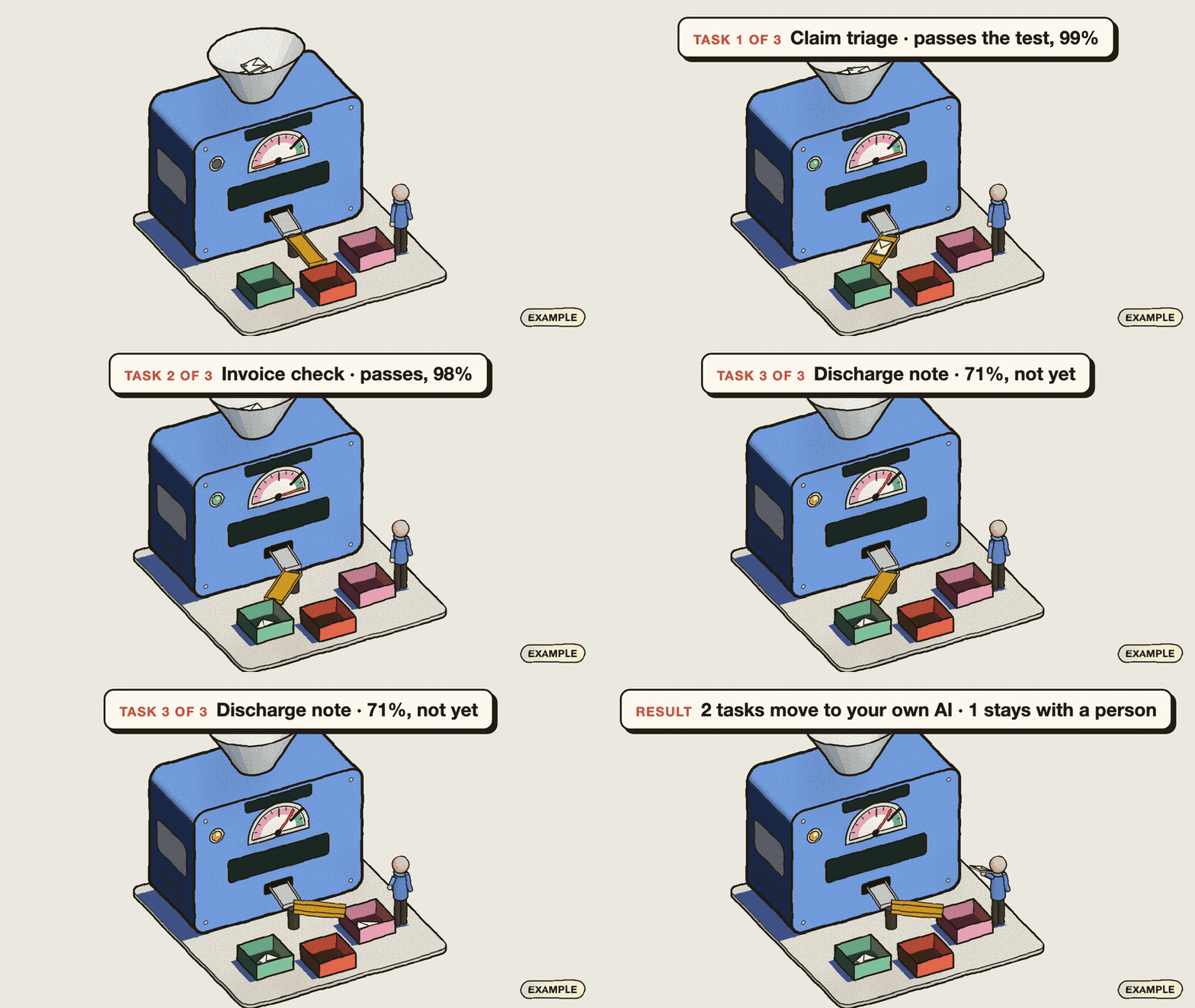
An illustration with example tasks, not customer data.
What is "your own AI"? An open model, such as Llama, Qwen or Gemma, running on your own computers. Use it as it is, or train it on your own past work with PraisonAI Train on your own GPU servers. Your team decides when to train; nothing trains automatically. Either way, a task moves to it only after it passes that exam.
Why now. Highly regulated teams, such as banks, insurers and hospitals, want AI but can't send customer data to outside models. The largest banks built private AI in-house; most mid-size banks and insurers can't fund a team to do that. From 6 January 2027, OpenAI also takes no new self-serve fine-tuning jobs (notice), so teams that customise models need models they own.
The handover is built on parts of this framework that are live today: tracing, evaluation, fine-tuning, model routing and local models. It is in early access, and we are taking on our first design partners. The framework stays free and MIT-licensed. Design partners, investors and press: enterprise@praison.ai or praison.ai/enterprise.
JavaScript and TypeScript
npm install praisonai
The TypeScript and JavaScript SDK has its own guide at praison.ai/docs/js.
const { Agent } = require('praisonai');
const agent = new Agent({ instructions: 'You are a helpful AI assistant' });
agent.start('Write a movie script about a robot in Mars');
Install
Desktop app



Other ways to install
One-line installer:
curl -fsSL https://praison.ai/install.sh | bash
The full praisonai package, with the CLI and integrations. Add the [dashboard] extra for bots and the dashboard (pip install "praisonai[dashboard]"):
 ██████╗ ██████╗  █████╗ ██╗███████╗ ██████╗ ███╗   ██╗     █████╗ ██╗
 ██╔══██╗██╔══██╗██╔══██╗██║██╔════╝██╔═══██╗████╗  ██║    ██╔══██╗██║
 ██████╔╝██████╔╝███████║██║███████╗██║   ██║██╔██╗ ██║    ███████║██║
 ██╔═══╝ ██╔══██╗██╔══██║██║╚════██║██║   ██║██║╚██╗██║    ██╔══██║██║
 ██║     ██║  ██║██║  ██║██║███████║╚██████╔╝██║ ╚████║    ██║  ██║██║
 ╚═╝     ╚═╝  ╚═╝╚═╝  ╚═╝╚═╝╚══════╝ ╚═════╝ ╚═╝  ╚═══╝    ╚═╝  ╚═╝╚═╝

 pip install praisonai
Docs, community and licence
- Documentation: praison.ai/docs
- Questions and bugs: Discussions · Issues
- Contributing: Contributing guide
- Videos and news: YouTube · X · LinkedIn
- Highlighted by Elon Musk: his post quoting our Grok 3 customer-support tutorial
- Desktop app: macOS, Windows and Linux builds are on the latest release
- Licence: MIT
The PraisonAI Ecosystem
Start simple with the core SDK, or expand to full visual builders and dashboards when you're ready.
- Core SDK (
praisonaiagents): For pure Python development.pip install praisonaiagents - 💻 PraisonAI CLI (
praisonai): For terminal-based developers.pip install praisonai - 🦅 PraisonAI Dashboard: Chat, agents, memory and knowledge, and connect agents to Telegram, Slack, or Discord.
pip install "praisonai[dashboard]" - 🔗 Flow Visual Builder: Drag-and-drop workflow creation.
pip install "praisonai[flow]" - 🤖 PraisonAI UI: Chat with a canvas for the tables and code your agents write.
pip install "praisonai[ui]"
JavaScript SDK
npm install praisonai
Supported Providers & Features
Powered by 100+ LLMs (OpenAI, Anthropic, Gemini & local models).





View all 24 providers with examples
| Provider | Example |
|---|---|
| OpenAI | Example |
| Anthropic | Example |
| Google Gemini | Example |
| Ollama | Example |
| Groq | Example |
| DeepSeek | Example |
| xAI Grok | Example |
| Mistral | Example |
| Cohere | Example |
| Perplexity | Example |
| Fireworks | Example |
| Together AI | Example |
| OpenRouter | Example |
| HuggingFace | Example |
| Azure OpenAI | Example |
| AWS Bedrock | Example |
| Google Vertex | Example |
| Databricks | Example |
| Cloudflare | Example |
| AI21 | Example |
| Replicate | Example |
| SageMaker | Example |
| Moonshot | Example |
| vLLM | Example |
Why PraisonAI?
| Feature | How | |
|---|---|---|
| 🔌 | MCP Protocol — stdio, HTTP, WebSocket, SSE | tools=MCP("npx ...") |
| 🧠 | Planning Mode — plan → execute → reason | planning=True |
| 🔍 | Deep Research — multi-step autonomous research | Docs |
| 🤖 | External Agents — orchestrate Claude Code, Gemini CLI, Codex | Docs |
| 🔄 | Agent Handoffs — seamless conversation passing | handoffs=[other_agent] |
| 🛡️ | Guardrails — input/output validation | Docs |
| Web Search + Fetch — native browsing | web=True | |
| 🪞 | Self Reflection — agent reviews its own output | Docs |
| 🔀 | Workflow Patterns — route, parallel, loop, repeat | Docs |
| 🧠 | Memory (zero deps) — works out of the box | memory=True |
View all 25 features
| Feature | How | |
|---|---|---|
| 💡 | Prompt Caching — reduce latency + cost | caching=True |
| 💾 | Sessions + Auto-Save — persistent state across restarts | auto_save="my-project" |
| 💭 | Thinking Budgets — control reasoning depth | agent.thinking_budget = 1024 |
| 📚 | RAG + Quality-Based RAG — auto quality scoring retrieval | Docs |
| 📊 | Model Router — auto-routes to cheapest capable model | Docs |
| 🧊 | Shadow Git Checkpoints — auto-rollback on failure | Docs |
| 📡 | A2A Protocol — agent-to-agent interop | Docs |
| 📏 | Context Compaction — never hit token limits | Docs |
| 📡 | Telemetry — OpenTelemetry traces, spans, metrics | Docs |
| 📜 | Policy Engine — declarative agent behavior control | Docs |
| 🔄 | Background Tasks — fire-and-forget agents | Docs |
| 🔁 | Doom Loop Detection — auto-recovery from stuck agents | Docs |
| 🕸️ | Graph Memory — Neo4j-style relationship tracking | Docs |
| 🏖️ | Sandbox Execution — isolated code execution | Docs |
| 🖥️ | Bot Gateway — multi-agent routing across channels | Docs |
Using Python Code
Show Python examples: single agent, multi-agent, MCP, tools, databases, Claw, Langflow, UI
Unsure whether a result is a bug or model randomness? Check the SDK Behavior Matrix for
stream, memory prefetch, structured output, teams and AG-UI.
1. Single Agent
from praisonai import Agent
agent = Agent(instructions="You are a helpful AI assistant")
agent.start("Write a movie script about a robot in Mars")
2. Multi Agents
from praisonai import Agent, Agents

research_agent = Agent(instructions="Research about AI")
summarise_agent = Agent(instructions="Summarise research agent's findings")
agents = Agents(agents=[research_agent, summarise_agent])
agents.start()
3. MCP (Model Context Protocol)
from praisonai import Agent, MCP

# stdio - Local NPX/Python servers
agent = Agent(tools=MCP("npx @modelcontextprotocol/server-memory"))

# Streamable HTTP - Production servers
agent = Agent(tools=MCP("https://api.example.com/mcp"))

# WebSocket - Real-time bidirectional
agent = Agent(tools=MCP("wss://api.example.com/mcp", auth_token="token"))

# With environment variables
agent = Agent(
    tools=MCP(
        command="npx",
        args=["-y", "@modelcontextprotocol/server-brave-search"],
        env={"BRAVE_API_KEY": "your-key"}
    )
)
📖 Full MCP docs — stdio, HTTP, WebSocket, SSE transports
4. Custom Tools
from praisonai import Agent, tool

@tool
def search(query: str) -> str:
    """Search the web for information."""
    return f"Results for: {query}"

@tool
def calculate(expression: str) -> float:
    """Safely evaluate a numeric arithmetic expression."""
    import ast
    import operator

    # Define allowed operations
    _OPS = {
        ast.Add: operator.add,
        ast.Sub: operator.sub,
        ast.Mult: operator.mul,
        ast.Div: operator.truediv,
        ast.Pow: operator.pow,
        ast.USub: operator.neg,
        ast.UAdd: operator.pos,
    }

    def _safe_eval(node):
        if isinstance(node, ast.Constant) and isinstance(node.value, (int, float)):
            return node.value
        elif isinstance(node, ast.BinOp) and type(node.op) in _OPS:
            return _OPS[type(node.op)](_safe_eval(node.left), _safe_eval(node.right))
        elif isinstance(node, ast.UnaryOp) and type(node.op) in _OPS:
            return _OPS[type(node.op)](_safe_eval(node.operand))
        else:
            raise ValueError("Unsupported expression")

    try:
        return _safe_eval(ast.parse(expression, mode="eval").body)
    except (ValueError, SyntaxError, TypeError, ZeroDivisionError, OverflowError):
        raise ValueError("Invalid arithmetic expression")

agent = Agent(
    instructions="You are a helpful assistant",
    tools=[search, calculate]
)
agent.start("Search for AI news and calculate 15*4")
⚠️ Security Note: Never use
eval(),exec(), orsubprocessin tool functions that process LLM-generated or user-supplied input. Always validate and sanitize inputs to prevent code injection attacks. 📖 Full tools docs — BaseTool, tool packages, 100+ built-in tools
5. Persistence (Databases)
from praisonai import Agent, db

agent = Agent(
    name="Assistant",
    memory={
        "db": db(database_url="postgresql://localhost/mydb"),
        "session_id": "my-session",
    },
)
agent.chat("Hello!")  # Auto-persists messages, runs, traces
📖 Full persistence docs — PostgreSQL, MySQL, SQLite, MongoDB, Redis, and 20+ more
6. PraisonAI Dashboard
Connect your AI agents to Telegram, Discord, Slack, WhatsApp and more — all from a single command.
pip install "praisonai[dashboard]"   # or: "praisonai[claw]" (the same extra)
praisonai dashboard                 # or: praisonai claw (the same app)
Required Environment Variables
Copy .env.example to .env and configure the following variables:
| Variable | Required | Description |
|---|---|---|
OPENAI_API_KEY | Yes | OpenAI API key for all LLM calls |
TAVILY_API_KEY | Yes (Dashboard) | Tavily key for the built-in web-search tool. Get one free at https://app.tavily.com |
Open http://localhost:8082 — the dashboard opens in Chat + Canvas: the chat on the left, and the tables, code and files your agents write on a canvas beside it (sort, copy, download, compare versions). Every other page (Agents, Memory, Knowledge, Channels, Guardrails, Cron, and more) is in the sidebar or the command palette (⌘K). Add messaging channels directly from the UI.
📖 Full Dashboard docs — platform tokens, CLI options, Docker, and YAML agent mode
7. Langflow Integration (Visual Flow Builder)
Build multi-agent workflows visually with drag-and-drop components in Langflow.
pip install "praisonai[flow]"
praisonai flow
Open http://localhost:7861 — use the Agent and Agent Team components to create sequential or parallel workflows. Connect Chat Input → Agent Team → Chat Output for instant multi-agent pipelines.
📖 Full Flow docs — visual agent building, component reference, and deployment
8. PraisonAI UI (Chat + Canvas)
Chat with your AI agents; the tables and code they write open on a canvas beside the chat.
pip install "praisonai[ui]"
praisonai ui            # chat           → http://localhost:8081
praisonai ui agents     # YAML agents
praisonai ui bot        # bot interface
praisonai ui realtime   # realtime voice
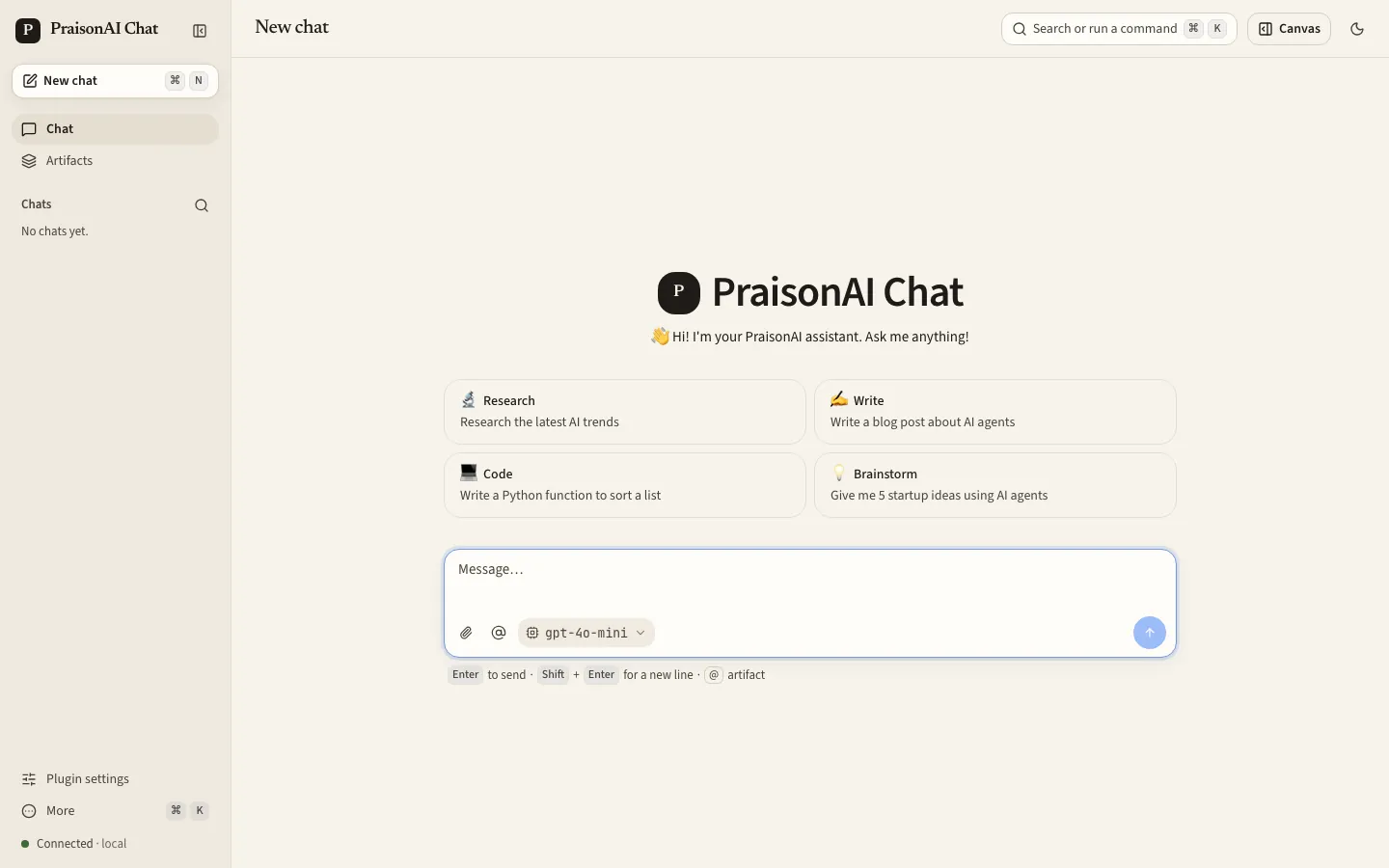
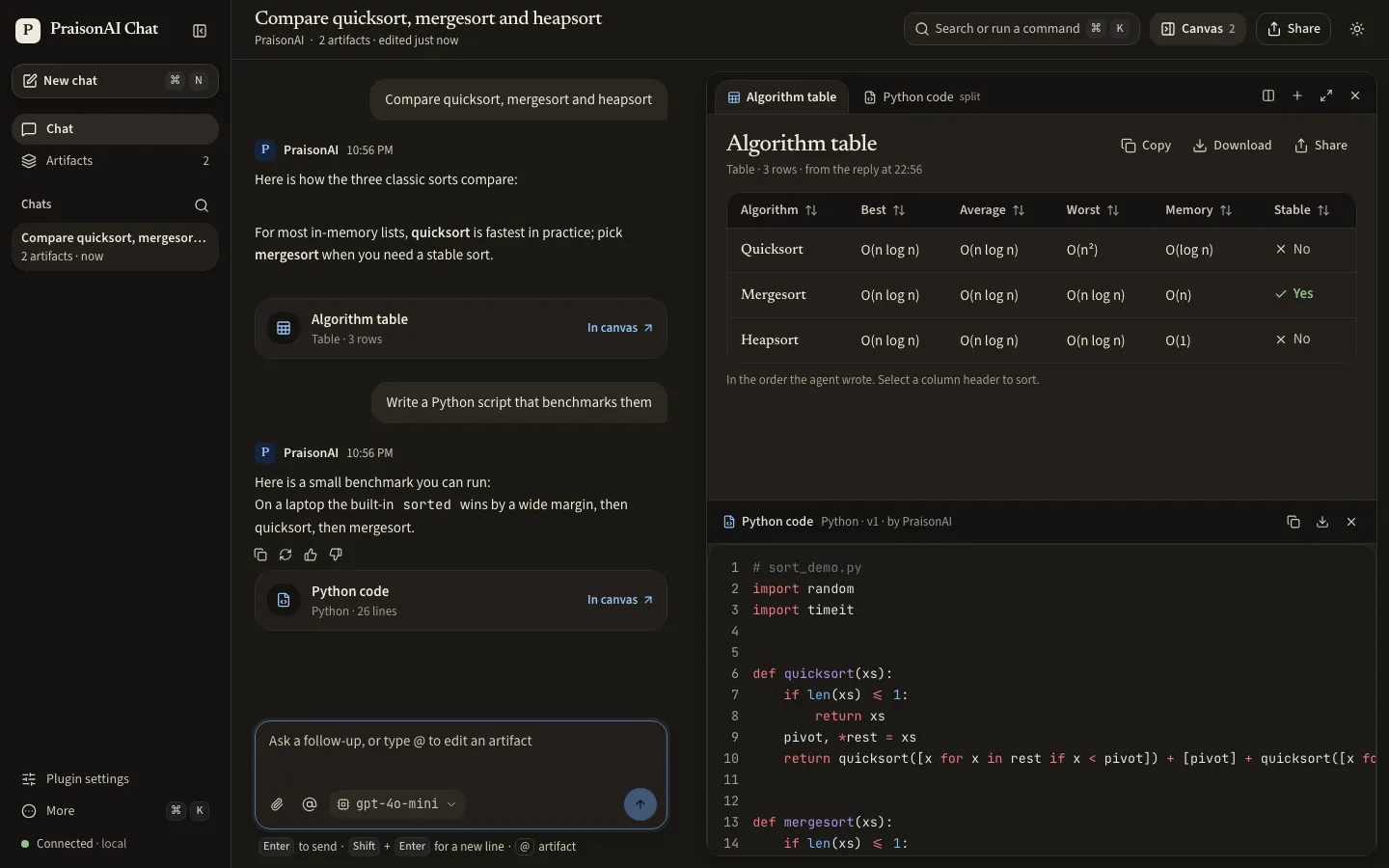
- Welcome: each app greets you in the new-chat hero, in every layout. Set the text with
UIPreset(welcome=...)or your own@aiui.welcomehandler. - Layout: Chat + Canvas by default. Pick another for one run with
AIUI_LAYOUT=chat(no canvas),workbench,command,guidedormission, or switch from the command palette (⌘K). - Look: light and dark follow the toggle in the top bar; ⌘K → Switch look: Pro swaps the Paper look for the plain one.
- Stop: the Stop button cancels the agent's reply. A reply that sends nothing for 10 minutes is cancelled too (
AIUI_REPLY_IDLE_TIMEOUT, in seconds;0turns it off). - Uploads: request bodies are capped at 25 MiB (
AIUI_MAX_BODY_MB;0turns it off). - Data: chat history is saved by PraisonAI under
~/.praisonai/sessions(setPRAISONAI_HOMEto move it); the UI's own settings live in~/.praisonaiui(setAIUI_DATA_DIRto move them). To keep both on a mounted volume, set both variables. - An existing
~/.praisonai/claw/app.pyfrom an older install keeps aiui's own default layout (Chat, no canvas) and has no welcome greeting; delete it to get the new default app, or addlayout="chat-canvas"to itsconfigure_host(...)call.
Using YAML (No Code)
Show YAML examples
Example 1: Two Agents Working Together
Create agents.yaml:
framework: praisonai
topic: "Write a blog post about AI"

agents:
  researcher:
    role: Research Analyst
    goal: Research AI trends and gather information
    instructions: "Find accurate information about AI trends"

  writer:
    role: Content Writer
    goal: Write engaging blog posts
    instructions: "Write clear, engaging content based on research"
Run with:
praisonai agents.yaml
The agents automatically work together sequentially
Example 2: Agent with Custom Tool
Create two files in the same folder:
agents.yaml:
framework: praisonai
topic: "Calculate the sum of 25 and 15"

agents:
  calculator_agent:
    role: Calculator
    goal: Perform calculations
    instructions: "Use the add_numbers tool to help with calculations"
    tools:
      - add_numbers
tools.py:
def add_numbers(a: float, b: float) -> float:
    """
    Add two numbers together.

    Args:
        a: First number
        b: Second number

    Returns:
        The sum of a and b
    """
    return a + b
Run with:
praisonai agents.yaml
💡 Tips:
- Use the function name (e.g.,
add_numbers) in the tools list, not the file name- Tools in
tools.pyare automatically discovered- The function's docstring helps the AI understand how to use it
CLI Quick Reference
| Category | Commands |
|---|---|
| Execution | praisonai, --auto, --interactive, --chat |
| Research | research, --query-rewrite, --deep-research |
| Planning | --planning, --planning-tools, --planning-reasoning |
| Workflows | workflow run, workflow list, workflow auto |
| Memory | memory show, memory add, memory search, memory clear |
| Knowledge | knowledge add, knowledge query, knowledge list |
| Sessions | session list, session resume, session delete |
| Tools | tools list, tools info, tools search |
| MCP | mcp list, mcp create, mcp enable |
| Development | commit, docs, checkpoint, hooks |
| Scheduling | schedule start, schedule list, schedule stop |
Key Features
Show all features by category
🤖 Core Agents
| Feature | Code | Docs |
|---|---|---|
| Single Agent | Example | 📖 |
| Multi Agents | Example | 📖 |
| Auto Agents | Example | 📖 |
| Self Reflection AI Agents | Example | 📖 |
| Reasoning AI Agents | Example | 📖 |
| Multi Modal AI Agents | Example | 📖 |
🔄 Workflows
| Feature | Code | Docs |
|---|---|---|
| Simple Workflow | Example | 📖 |
| Workflow with Agents | Example | 📖 |
Agentic Routing (route()) | Example | 📖 |
Parallel Execution (parallel()) | Example | 📖 |
Loop over List/CSV (loop()) | Example | 📖 |
Evaluator-Optimizer (repeat()) | Example | 📖 |
| Conditional Steps | Example | 📖 |
| Workflow Branching | Example | 📖 |
| Workflow Early Stop | Example | 📖 |
| Workflow Checkpoints | Example | 📖 |
💻 Code & Development
| Feature | Code | Docs |
|---|---|---|
| Code Interpreter Agents | Example | 📖 |
| AI Code Editing Tools | Example | 📖 |
| External Agents (All) | Example | 📖 |
| Claude Code CLI | Example | 📖 |
| Gemini CLI | Example | 📖 |
| Codex CLI | Example | 📖 |
| Cursor CLI | Example | 📖 |
🧠 Memory & Knowledge
| Feature | Code | Docs |
|---|---|---|
| Memory (Short & Long Term) | Example | 📖 |
| File-Based Memory | Example | 📖 |
| Claude Memory Tool | Example | 📖 |
| Add Custom Knowledge | Example | 📖 |
| RAG Agents | Example | 📖 |
| Chat with PDF Agents | Example | 📖 |
| Data Readers (PDF, DOCX, etc.) | CLI | 📖 |
| Vector Store Selection | CLI | 📖 |
| Retrieval Strategies | CLI | 📖 |
| Rerankers | CLI | 📖 |
| Index Types (Vector/Keyword/Hybrid) | CLI | 📖 |
| Query Engines (Sub-Question, etc.) | CLI | 📖 |
🔬 Research & Intelligence
| Feature | Code | Docs |
|---|---|---|
| Deep Research Agents | Example | 📖 |
| Query Rewriter Agent | Example | 📖 |
| Native Web Search | Example | 📖 |
| Built-in Search Tools | Example | 📖 |
| Unified Web Search | Example | 📖 |
| Web Fetch (Anthropic) | Example | 📖 |
📋 Planning & Execution
| Feature | Code | Docs |
|---|---|---|
| Planning Mode | Example | 📖 |
| Planning Tools | Example | 📖 |
| Planning Reasoning | Example | 📖 |
| Prompt Chaining | Example | 📖 |
| Evaluator Optimiser | Example | 📖 |
| Orchestrator Workers | Example | 📖 |
👥 Specialized Agents
| Feature | Code | Docs |
|---|---|---|
| Data Analyst Agent | Example | 📖 |
| Finance Agent | Example | 📖 |
| Shopping Agent | Example | 📖 |
| Recommendation Agent | Example | 📖 |
| Wikipedia Agent | Example | 📖 |
| Programming Agent | Example | 📖 |
| Math Agents | Example | 📖 |
| Markdown Agent | Example | 📖 |
| Prompt Expander Agent | Example | 📖 |
🎨 Media & Multimodal
| Feature | Code | Docs |
|---|---|---|
| Image Generation Agent | Example | 📖 |
| Image to Text Agent | Example | 📖 |
| Video Agent | Example | 📖 |
| Camera Integration | Example | 📖 |
🔌 Protocols & Integration
| Feature | Code | Docs |
|---|---|---|
| MCP Transports | Example | 📖 |
| WebSocket MCP | Example | 📖 |
| MCP Security | Example | 📖 |
| MCP Resumability | Example | 📖 |
| MCP Config Management | Docs | 📖 |
| LangChain Integrated Agents | Example | 📖 |
🛡️ Safety & Control
| Feature | Code | Docs |
|---|---|---|
| Guardrails | Example | 📖 |
| Human Approval | Example | 📖 |
| Rules & Instructions | Docs | 📖 |
⚙️ Advanced Features
| Feature | Code | Docs |
|---|---|---|
| Async & Parallel Processing | Example | 📖 |
| Parallelisation | Example | 📖 |
| Repetitive Agents | Example | 📖 |
| Agent Handoffs | Example | 📖 |
| Stateful Agents | Example | 📖 |
| Autonomous Workflow | Example | 📖 |
| Structured Output Agents | Example | 📖 |
| Model Router | Example | 📖 |
| Prompt Caching | Example | 📖 |
| Fast Context | Example | 📖 |
🛠️ Tools & Configuration
| Feature | Code | Docs |
|---|---|---|
| 100+ Custom Tools | Example | 📖 |
| YAML Configuration | Example | 📖 |
| 100+ LLM Support | Example | 📖 |
| Callback Agents | Example | 📖 |
| Hooks | Example | 📖 |
| Middleware System | Example | 📖 |
| Configurable Model | Example | 📖 |
| Rate Limiter | Example | 📖 |
| Injected Tool State | Example | 📖 |
| Shadow Git Checkpoints | Example | 📖 |
| Background Tasks | Example | 📖 |
| Policy Engine | Example | 📖 |
| Thinking Budgets | Example | 📖 |
| Output Styles | Example | 📖 |
| Context Compaction | Example | 📖 |
📊 Monitoring & Management
| Feature | Code | Docs |
|---|---|---|
| Sessions Management | Example | 📖 |
| Auto-Save Sessions | Docs | 📖 |
| History in Context | Docs | 📖 |
| Telemetry | Example | 📖 |
| Langfuse Tracing | Docs | 📖 |
| Project Docs (.praison/docs/) | Docs | 📖 |
| AI Commit Messages | Docs | 📖 |
| @Mentions in Prompts | Docs | 📖 |
🖥️ CLI Features
| Feature | Code | Docs |
|---|---|---|
| Slash Commands | Example | 📖 |
| Autonomy Modes | Example | 📖 |
| Cost Tracking | Example | 📖 |
| Repository Map | Example | 📖 |
| Interactive TUI | Example | 📖 |
| Git Integration | Example | 📖 |
| Sandbox Execution | Example | 📖 |
| CLI Compare | Example | 📖 |
| Profile/Benchmark | Docs | 📖 |
| Auto Mode | Docs | 📖 |
| Init | Docs | 📖 |
| File Input | Docs | 📖 |
| Final Agent | Docs | 📖 |
| Max Tokens | Docs | 📖 |
Performance
PraisonAI keeps framework overhead microsecond-class: creating an Agent (one tool, no LLM call) averaged 46 μs in our 2026-10-15 run, so per-agent setup is negligible next to model latency in multi-agent workloads.
| Performance Metric | PraisonAI | Measured |
|---|---|---|
| Avg Agent instantiation (1 tool, 1000 iterations) | 46 μs | 2026-10-15 · praisonaiagents 1.7.12 |
Methodology, comparisons and how to reproduce: benchmarks/BENCHMARK_RESULTS.md · docs
Langfuse Tracing
pip install "praisonai[langfuse]"
praisonai langfuse
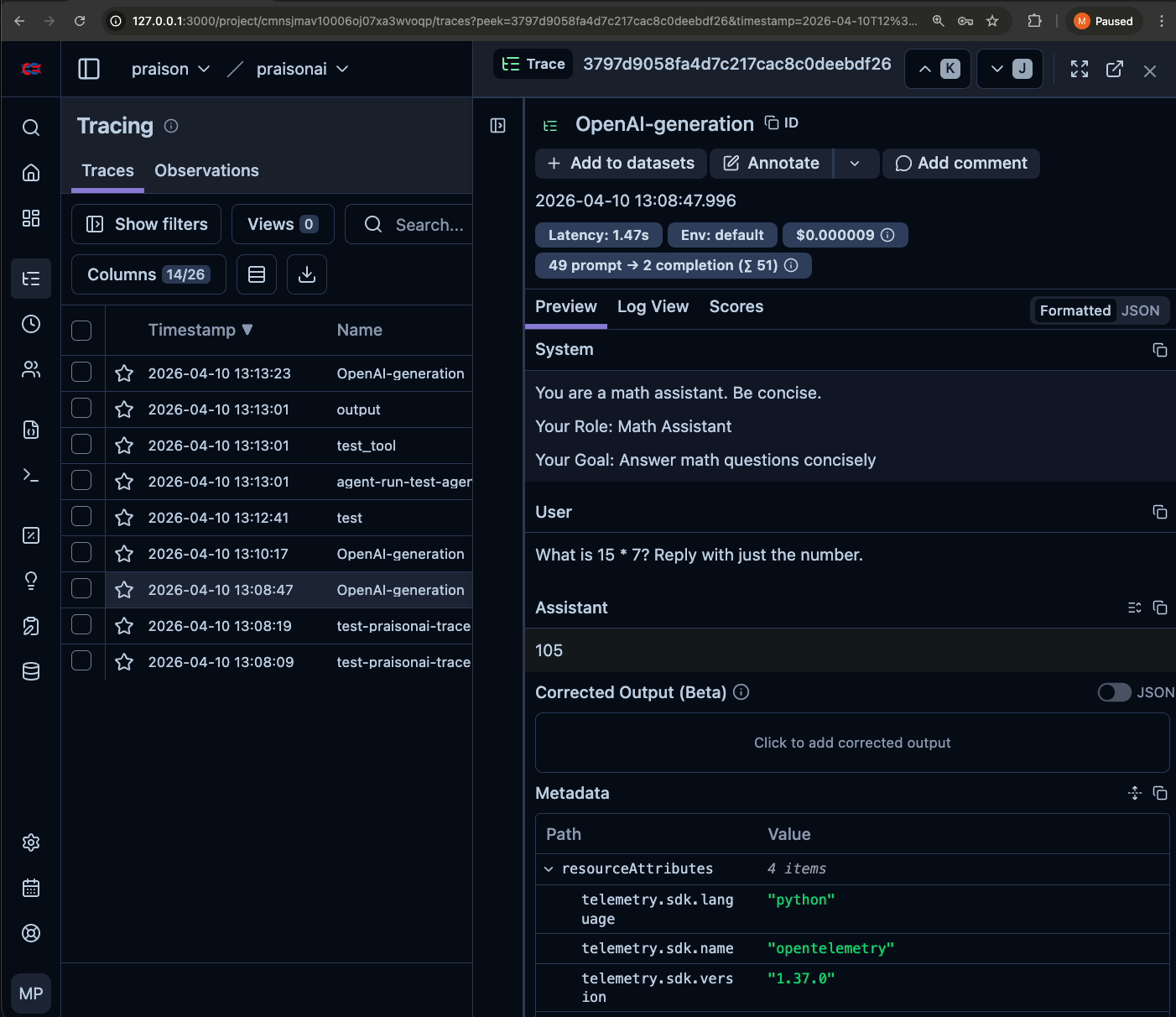
Video Tutorials
Learn PraisonAI through our comprehensive video series:
View all 22 video tutorials
| Topic | Video |
|---|---|
| AI Agents with Self Reflection |  |
| Reasoning Data Generating Agent |  |
| AI Agents with Reasoning |  |
| Multimodal AI Agents |  |
| AI Agents Workflow |  |
| Async AI Agents |  |
| Mini AI Agents |  |
| AI Agents with Memory |  |
| Repetitive Agents |  |
| Introduction |  |
| Tools Overview |  |
| Custom Tools |  |
| Firecrawl Integration |  |
| User Interface |  |
| Crawl4AI Integration |  |
| Chat Interface |  |
| Code Interface |  |
| Mem0 Integration |  |
| Training |  |
| Realtime Voice Interface |  |
| Call Interface |  |
| Reasoning Extract Agents |  |
Contributing
We welcome contributions! Fork the repo, create a branch, and submit a PR → Contributing Guide.
FAQ & Troubleshooting
Show FAQ and troubleshooting
ModuleNotFoundError: No module named 'praisonai'
Install the package:
pip install praisonai
Using only the core library? pip install praisonaiagents and import from praisonaiagents instead.
API key not found / Authentication error
Ensure your API key is set:
export OPENAI_API_KEY=your_key_here
For other providers, see Models docs.
How do I use a local model (Ollama)?
# Start Ollama and pull a model
ollama serve
ollama pull llama3.2
from praisonai import Agent

agent = Agent(instructions="You are a helpful assistant", llm="ollama/llama3.2")
agent.start("Why is the sky blue?")
The ollama/ prefix is what selects Ollama's handling — tool-call repair,
tool-result formatting and the streaming rules small local models need. Or set
it by environment instead:
export OPENAI_MODEL_NAME=ollama/llama3.2
Setting only OPENAI_BASE_URL is not enough: with no model named, the OpenAI
default (gpt-4o-mini) is sent to Ollama, which answers
404 model 'gpt-4o-mini' not found. Always name the model.
Point at a non-default host with base_url= or OLLAMA_HOST:
agent = Agent(instructions="...", llm="ollama/llama3.2", base_url="http://192.168.1.10:11434")
The same shape works for other local runtimes — lm_studio/, vllm/ and
hosted_vllm/ with their server's base_url.
See Models docs for more details.
How do I persist conversations to a database?
Use the db parameter:
from praisonai import Agent, db

agent = Agent(
    name="Assistant",
    memory={
        "db": db(database_url="postgresql://localhost/mydb"),
        "session_id": "my-session",
    },
)
See Persistence docs for supported databases.
How do I enable agent memory?
from praisonai import Agent

agent = Agent(
    name="Assistant",
    # Enables file-based memory (no extra deps!)
    memory={"user_id": "user123"},
)
See Memory docs for more options.
How do I run multiple agents together?
from praisonai import Agent, Agents

agent1 = Agent(instructions="Research topics")
agent2 = Agent(instructions="Summarize findings")
agents = Agents(agents=[agent1, agent2])
agents.start()
See Agents docs for more examples.
How do I use MCP tools?
from praisonai import Agent, MCP

agent = Agent(
    tools=MCP("npx @modelcontextprotocol/server-memory")
)
See MCP docs for all transport options.
Getting Help
Made with ❤️ by the PraisonAI Team
📚 Documentation • GitHub • ▶️ YouTube • 𝕏 X • 💼 LinkedIn
What's new
| What's new | What it is |
|---|---|
| Six products, one framework | Bot, Code, MCP and Train now install on their own: pip install praisonai-bot, praisonai-code, praisonai-mcp, praisonai-train. pip install praisonai still installs everything. |
praisonai connect | One command puts your agents and 85 tools in 22 MCP clients: Cursor, VS Code, Claude Desktop, Claude Code, Codex, Zed and more. |
| Replay | Record any agent run, then replay it step by step, rerun from a node, or export it to HTML, Mermaid or OpenTelemetry. |
| Dashboard | Chat + Canvas, a microphone in the composer, and a Connect page for MCP clients. pip install "praisonai[dashboard]" |
| v4.8.0 | A security hardening release. 608 releases in the last 12 months. |