klypix-mcp
Shared project memory for your coding agents, kept in your repo.
One project. Many agents. One current understanding.


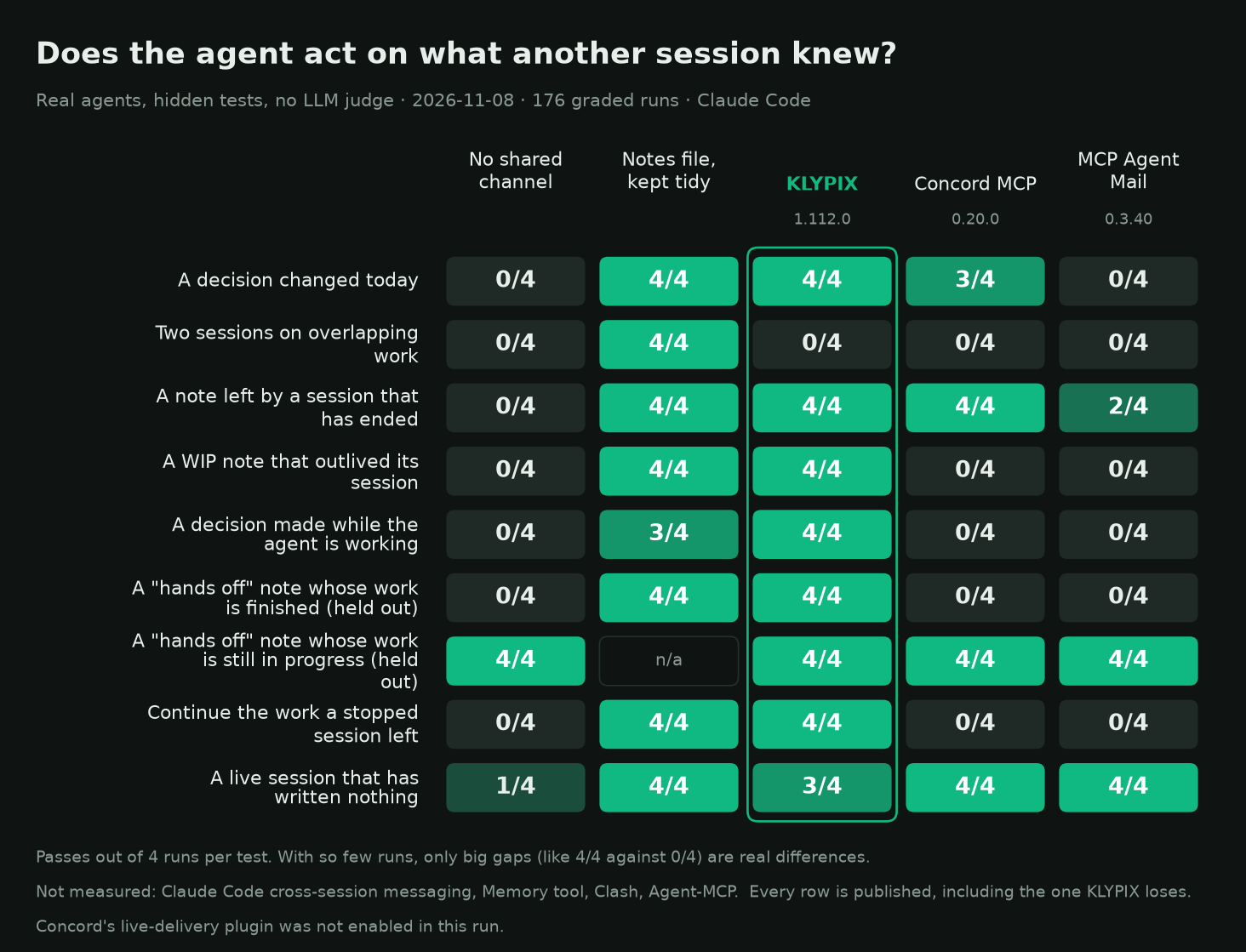
Real Claude Code sessions, hidden tests, no LLM judge, 8 Nov 2026. Drawn by CI from the results file; every row is published, including the one KLYPIX loses. Four runs per cell; the report does not establish a general ranking. Concord's live-delivery plugin was not enabled in this run. See the comparison scope and configuration limits.
One brain.klypix file, committed with your code, holds what the project decided, what was
corrected, and what is still open. Claude Code, Codex, Cursor and other MCP coding tools read it
when a session starts and add to it as they work. When two sessions plan to touch the same file,
both get a heads-up. A person can open the same file and correct it.
Three things worth knowing before you install:
- It runs without the app and without an account. Linux, macOS and Windows. The engine makes no network calls and sends no telemetry.
- Agents read plain text. The brief lands in
AGENTS.md/CLAUDE.mdas a managed block, so every tool that reads instruction files already understands it. - Six tools by default.
brain_sync,brain_note,brain_ask,brain_message,brain_handoff,brain_rules. The other 23 (24 on Windows) are one flag away.
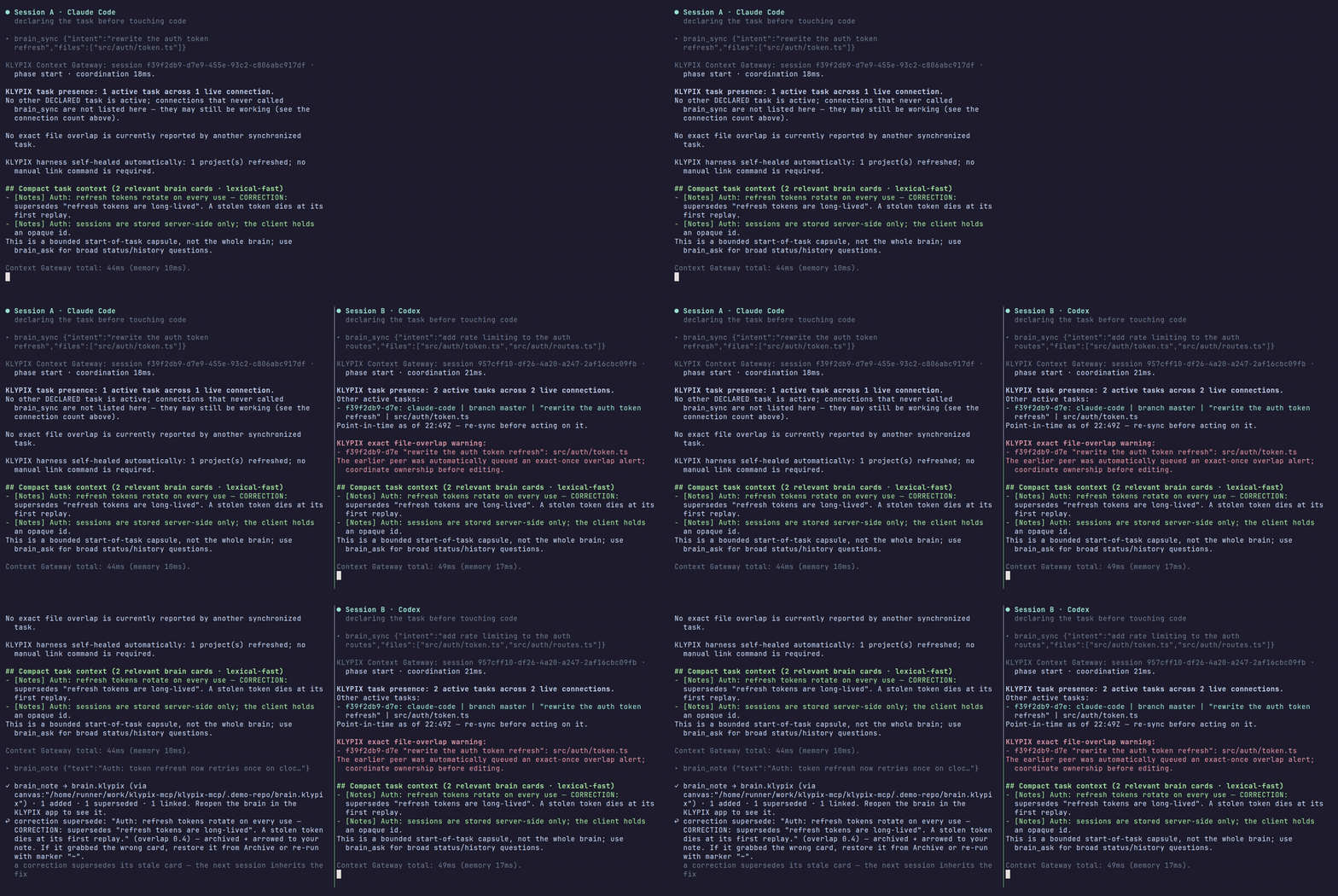
Real output, rendered by CI from a scripted run against this server, sped up 1.4×. How it is made.
Install
You need Node.js 20 or newer. Run this inside your project:
npx klypix-mcp install
It gives the project a brain.klypix if it has none, wires the editors it finds on this machine
with the six core tools, registers the card-level .klypix merge driver in a git repo, and opens a
real MCP handshake to prove the tools answer before it exits. Reopen your coding tool, then:
npx klypix-mcp doctor # what is installed, which profile, how many tools answered
No project at hand? Read the sample brain that ships in the package, a fictional weather app:
npx klypix-read node_modules/klypix-mcp/examples/showcase-brain.klypix
Want everything? npx klypix-mcp install --tools all, or set KLYPIX_TOOLS=all in the server's
environment. A comma list such as KLYPIX_TOOLS=brain_sync,brain_note also works.
What you get
- A brief at the start of every session. The next session, in the same tool or another one, starts from what the project already decided. A correction replaces the old decision and keeps it as history.
- A heads-up when work overlaps. Each session says what it is doing and which files it expects to touch. When two sessions name the same file, both are told. Since 1.112.0 this covers every git worktree of one repository, not only one folder. KLYPIX warns; it never blocks an edit. See it across two worktrees (real output, rendered by CI).
- Notes and handoffs between sessions. An agent can leave a note for another session, even one that has closed. When a session stops before its work is done, the next one is shown what it was doing, and a handoff card carries the next steps through git.
- A one-line check for hooks and CI.
npx klypix-mcp check src/auth.tsexits 1 when a live session on this computer is working on that file, 0 when none is, 2 when it cannot tell. Use it in a pre-edit hook or a pre-commit step; you decide what to do with the answer. Hook and CI snippets. - A file you own. The brain is a plain ZIP in your repo, versioned with git, mergeable card by card. MIT-licensed. Brain data stays in your files; your agent's model provider still receives what the agent reads.
Hosts
| Host | What it gets | Set up by |
|---|---|---|
| Claude Code | Lifecycle hooks: a brief at session start, context on each prompt, automatic capture at turn end, presence and a git guard for a shared checkout | install |
| Codex | MCP tools, presence and brain_sync; optional hooks with --codex-hooks. No automatic capture | install |
| Cursor, Cline, VS Code (Copilot / Continue), Gemini CLI, Antigravity | MCP config and an always-on rules file. The agent calls brain_sync and brain_note itself | install or link |
| Windsurf, Aider | A rules file | link |
| Claude, as a plugin | One pinned version, keyword search, no hooks | klypix-plugin |
The full host table says exactly how deep each integration goes.
The numbers, including the ones we lose
The coordination bench runs real Claude Code and Codex sessions on seeded repositories and grades them with hidden tests; there is no LLM judge. The full run of 8 November 2026 put klypix-mcp 1.112.0 next to Concord MCP 0.20.0, MCP Agent Mail 0.3.40, a notes file kept tidy by hand, and no shared channel (write-up):
- Clear wins over Concord and Agent Mail on four of nine scenarios: a work-in-progress note that outlived its session, its held-out twin, a decision made while the agent was working, and continuing the work a stopped session left. KLYPIX 4 of 4 each, both others 0 of 4.
- Ties on a changed decision, a note from an ended session, a live session that wrote nothing, and the harm check.
- One loss, shared by every channel: on two sessions changing overlapping work, a tidy notes file passed 4 of 4 and KLYPIX, Concord and Agent Mail 0 of 4. All three delivered the warning; the agents chose to tell the human rather than merge.
- A notes file kept tidy by hand ties KLYPIX on most scenarios. What it needs is a person who keeps it tidy.
- Codex, 3 runs each on four scenarios: KLYPIX 9 of 12, Agent Mail 5 of 12, Concord 0 of 12. Three runs is too few to call any single scenario.
Four runs per cell (five were planned; the run stopped at its budget). Clash and Agent-MCP are not measured: no adapter exists. Claude spend $88.99; no run was invalid.
npm download counts for this package are mostly its own updater checking for new versions; do not read them as users.
How klypix-mcp compares to Concord MCP, MCP Agent Mail, Clash and Agent-MCP, from their own READMEs.
Reference
Everything else is in docs/REFERENCE.md: how the brain works, every tool, the command line, the git merge driver and the git guard, teammates on other computers over KLYPIX network, the Claude plugin, security and permissions, current limitations, uninstall.
Guides: shared project memory setup · klypix.com/klypix-mcp
KLYPIX does not launch, run, supervise or replace your agents. It is not an agent runtime, a model router, a worktree manager or a replacement for git. It holds what the project currently believes. The optional KLYPIX workspace lets people inspect and correct the same brain beside their files.
Contributing
Issues and pull requests: github.com/dahshanlabs/klypix-mcp.
Questions: hello@klypix.com. Run the tests with npm test from a clone.
Licence
MIT (LICENSE, history in NOTICE). Versions 1.29.0 through 1.111.0
were Apache-2.0; each published version keeps the terms it was released with. The KLYPIX desktop
app and klypix.com are separate, proprietary products; this package works with no app installed.
MIT © Dahshan Labs.