LLM Preflight
Last reviewed: 2026-11-18 · As of: v2.25.8


Check LLM responses against the output rules your application depends on—before changing a model, prompt, schema, or provider.
Define the JSON shape, routing labels, or exact output your feature needs.
Check responses against those rules, preview provider requests and estimated
cost, and keep the decision, latency and cost as evidence for the change review.
It also tells you which literal model IDs in your code are retired or retiring
(Anthropic, OpenAI and selected Gemini models; Foundry MAI-Thinking-1 for
configured models, not the source scan).
A passing run is evidence for your account, prompts and validators. It is not production approval.
Built for engineers maintaining an LLM feature. Runs locally as a CLI, GitHub Action, or MCP server. Python 3.10+; no third-party runtime dependencies.
Try it · Observed models · Use your own contract · CI and agents
Try it in 60 seconds
In a new directory, install the tool. No API key or provider request is needed:
python3 -m venv .venv
. .venv/bin/activate
python3 -m pip install llm-preflight
The activation command is for POSIX shells; PowerShell uses
.\.venv\Scripts\Activate.ps1.
Already have LLM code? llm-preflight --audit-source . reports literal model
IDs marked retired or retiring in the bundled snapshot. No config or key is
needed. Real output from a one-file fixture repo whose app.py names
claude-3-opus-20240229 (complete output):
Decision: fail — 1 file audited; 1 model reference: 1 retired, 0 retiring or stale, 0 unknown.
Exit 0 — add --ci to exit 1 on this decision.
Files: tracked by git, plus untracked files .gitignore does not exclude.
Retired:
  claude-3-opus-20240229 (1 reference) — retired 2026-01-05, replacement claude-opus-4-8
    app.py:3
    Next: llm-preflight --quick "<your prompt>" --models anthropic:claude-3-opus-20240229,anthropic:claude-opus-4-8 --dry-run
Bundled rows go stale 30 days after review; doctor and dry-run JSON show the
end of the selected models' window as snapshot.valid_until (scan JSON:
retirement_snapshot.valid_until).
Why not just a pytest assert? A pytest assert checks one reply inside your test suite. This adds a merge gate tied to a fresh CI record of the contract check; see How it compares.
1. Catch an invalid response
Save this as routing.json. The app accepts billing, technical or
account. The config has two response fixtures: model-reply must pass and
negative-control (INVALID) must fail:
{
  "prompt": "I was charged twice. Reply with only the support queue label.",
  "models": [{"name": "local-mock", "provider": "mock", "model": "local"}],
  "validation": {"allowed_values": ["billing", "technical", "account"]},
  "validation_fixtures": [
    {"name": "model-reply", "response": "billing", "expect": "pass"},
    {"name": "negative-control", "response": "INVALID", "expect": "fail"}
  ]
}
llm-preflight routing.json --contract-check --no-env-file
Both fixtures behave as expected and the command exits 0. Now change the
model-reply response from billing to sales and run it again: the check
fails and exits 1. Restore billing and it passes again. The 23-second
session below runs the same validator (allowed_values billing, technical,
account) and the same two fixtures through the same pass, fail, pass flow, with
its own prompt and file name:
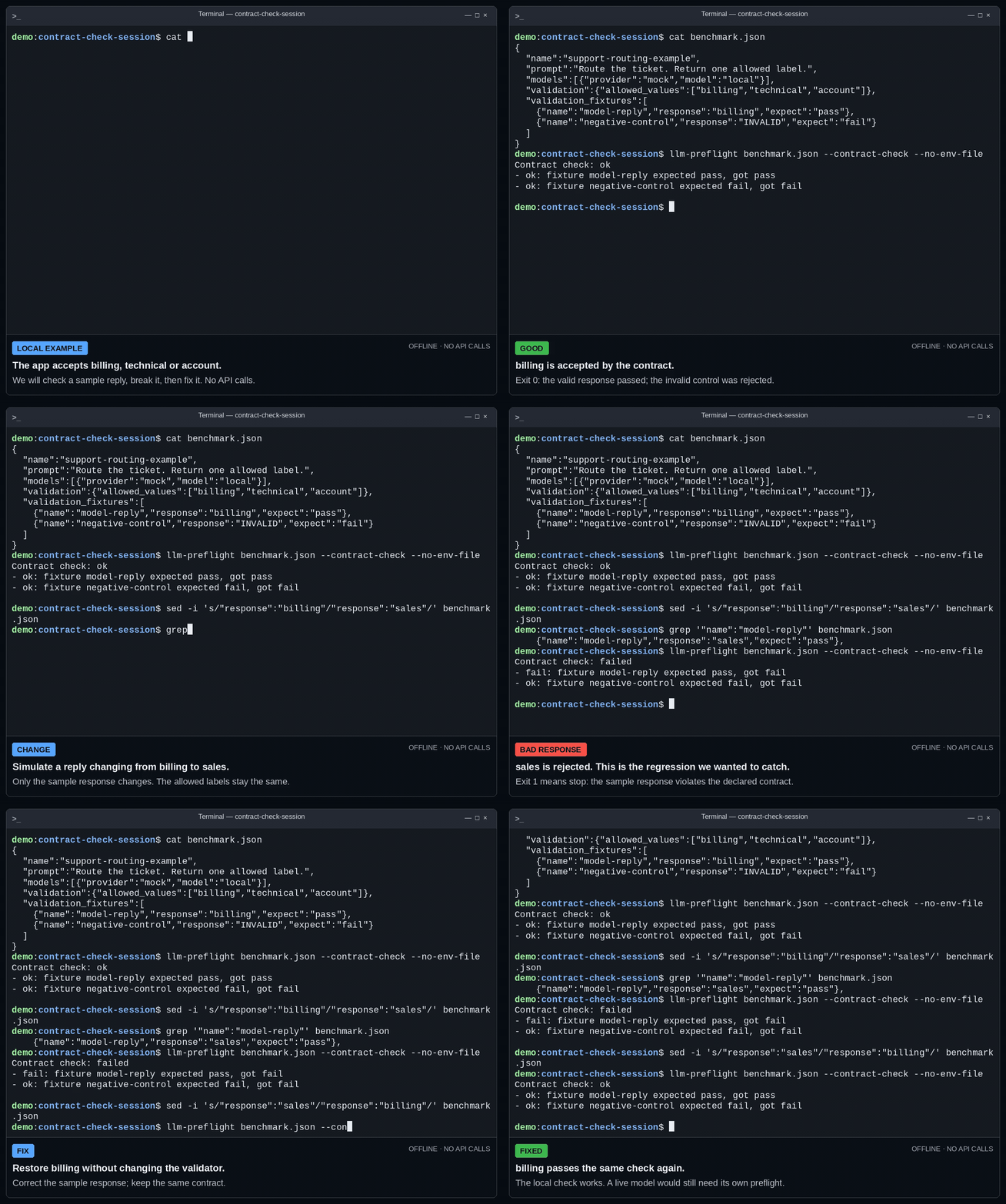
Real CLI output with synthetic response fixtures. This checks the validator; it makes no provider requests and does not execute your application's parser. Watch the MP4.
--contract-check exits 0 when every fixture behaves as expected, 1 when
one does not, and 2 for an invalid config.
2. Now a mock benchmark run
The mock benchmark uses a different config and produces a different decision:
llm-preflight init
llm-preflight benchmark.json --no-save --no-env-file
The config file is named benchmark.json because it also drives benchmark runs;
the same file holds a contract's validators and fixtures.
init refuses to overwrite an existing config. Look for local-mock with
PASS in the quality gate: the mock replied ok and passed the exact-output
test. The overall decision is inconclusive (exit 3) because a local mock
provides no live-provider evidence. The demo worked; it cannot approve a model.
--no-save skips JSON/Markdown result artifacts; --no-env-file skips credential files.
Watch the interactive default template (30 seconds)
Select the mock and default Reply with ok test, review the plan, and confirm
the local run. The session also reads the same decision through CLI JSON:
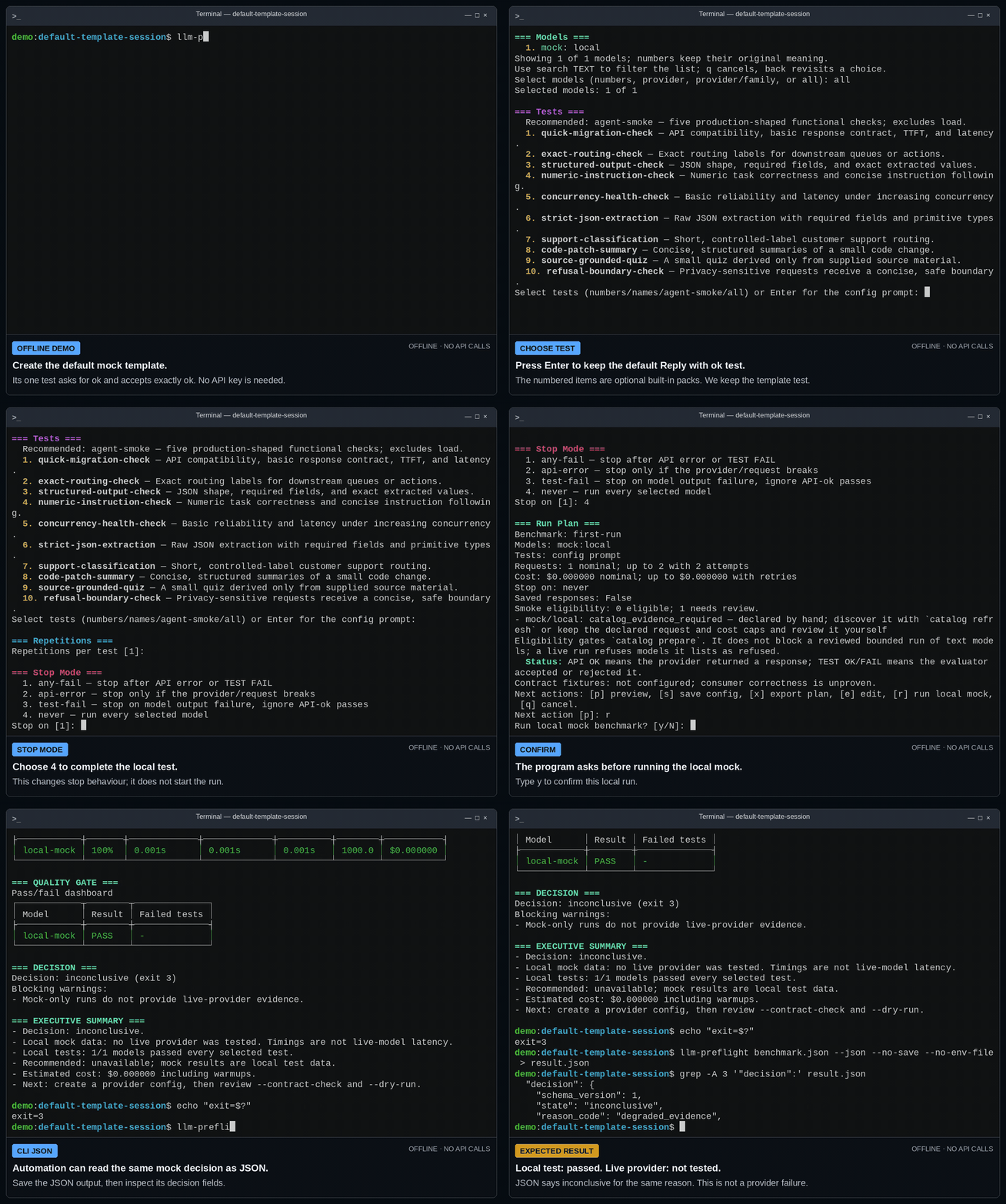
Local test: passed. Live provider: not tested. No API keys or provider calls. Watch the MP4 or start with the text walkthrough and interactive CLI JSON example.
Read the decision
For benchmark runs, read the decision before acting:
pass, exit0: the configured checks passed with the required evidence.fail, exit1: a configured check failed; inspect the cause.inconclusive, exit3: evidence is insufficient; read the blocking warnings.
New
Claude Fable 5.2, Gemini 3.1 Flash-Lite, Gemini 4 Hydrogen, Gemini 4 Neon, Qwen4 Max, GPT-6.2 Sol, GPT-6.2 Astra and four more models in the comparison guide. The guide covers 31 routes; the 31st, Claude Mythos 5.2, returned HTTP 404 on all eight calls. Everything else is on the releases page.
Observed results on a support-routing contract
We ran 30 native model routes through eight synthetic support-routing and strict JSON cases each. 233 of 240 checks passed: two outputs failed their contract and five Kimi calls returned HTTP 429. 27 models passed all eight checks. These are observations for this workload as of 2026-11-19, not a ranking of general intelligence or production approval.

Each request used a 1,024-token output allowance and one attempt, with no retries. Passed counts valid outputs out of API responses; API errors are separate, so Kimi's 3/3 with 5 errors is an incomplete evaluation. Latency averages API responses only. The known token-cost subtotal is $0.13850869 across 235 calls with usage; the total is unknown because the five error responses supplied no usage. Routes and settings differ, so read the comparison guide before comparing rows. It has the method and the failure analysis.
The same 30 rows as a table
| Model | Route | Group | Contract passed | API errors | Latency | Est. cost | Measured | Against 2026-10-29 |
|---|---|---|---|---|---|---|---|---|
| GPT-6.2 Astra | OpenAI | Passed 8/8 | 8/8 | 0 | 3.370s | $0.008224 | 2026-11-18 | — |
| GPT-6.2 Sol | OpenAI | Passed 8/8 | 8/8 | 0 | 1.471s | $0.002076 | 2026-11-18 | — |
| GPT-6 Astra | OpenAI | Passed 8/8 | 8/8 | 0 | 2.089s | $0.010580 | 2026-10-29 | — |
| GPT-6.1 Sol | OpenAI | Passed 8/8 | 8/8 | 0 | 1.476s | $0.002116 | 2026-10-29 | — |
| GPT-6.1 Terra | OpenAI | Passed 8/8 | 8/8 | 0 | 1.192s | $0.001218 | 2026-10-29 | — |
| GPT-6 Luna | OpenAI | Passed 8/8 | 8/8 | 0 | 1.205s | $0.000174 | 2026-10-29 | — |
| Claude Fable 5.2 | Anthropic | Passed 8/8 | 8/8 | 0 | 1.923s | $0.013160 | 2026-11-11 | — |
| Claude Fable 5.1 | Anthropic | Passed 8/8 | 8/8 | 0 | 0.923s | $0.014500 | 2026-10-29 | — |
| Claude Opus 5.5 | Anthropic | Passed 8/8 | 8/8 | 0 | 1.497s | $0.005740 | 2026-10-29 | — |
| Claude Sonnet 5.5 | Anthropic | Passed 8/8 | 8/8 | 0 | 1.421s | $0.002870 | 2026-10-29 | — |
| Claude Haiku 5.5 | Anthropic | Passed 8/8 | 8/8 | 0 | 1.758s | $0.000150 | 2026-10-29 | — |
| Gemini 4 Argon | Gemini | Passed 8/8 | 8/8 | 0 | 5.186s | $0.002728 | 2026-10-29 | — |
| Gemini 4 Carbon | Gemini | Passed 8/8 | 8/8 | 0 | 4.687s | $0.002728 | 2026-11-11 | — |
| Gemini 4 Hydrogen | Gemini | Passed 8/8 | 8/8 | 0 | 2.784s | $0.007221 | 2026-11-13 | — |
| Gemini 4 Neon | Gemini | Passed 8/8 | 8/8 | 0 | 15.874s | $0.024972 | 2026-11-19 | — |
| Gemini 3.8 Flash | Gemini | Passed 8/8 | 8/8 | 0 | 2.621s | $0.002723 | 2026-10-29 | — |
| Gemini 3.6 Flash | Gemini | Passed 8/8 | 8/8 | 0 | 1.359s | $0.004005 | 2026-10-29 | — |
| Gemini 3.1 Flash-Lite | Gemini | Passed 8/8 | 8/8 | 0 | 1.050s | $0.001793 | 2026-11-11 | — |
| Grok 4.7 | xAI | Passed 8/8 | 8/8 | 0 | 1.567s | $0.007536 | 2026-10-29 | — |
| DeepSeek V4 Pro | DeepSeek | Passed 8/8 | 8/8 | 0 | 1.766s | $0.004220 | 2026-10-29 | — |
| DeepSeek Flash | DeepSeek | Passed 8/8 | 8/8 | 0 | 1.297s | $0.000809 | 2026-10-29 | — |
| Qwen4 Max | Alibaba Singapore | Passed 8/8 | 8/8 | 0 | 2.676s | $0.002148 | 2026-11-17 | — |
| Qwen 3.8 Max | Alibaba Singapore | Passed 8/8 | 8/8 | 0 | 3.834s | $0.006034 | 2026-10-29 | — |
| Qwen 3.8 Flash | Alibaba Singapore | Passed 8/8 | 8/8 | 0 | 2.689s | $0.000547 | 2026-11-11 | — |
| MiniMax M3 | MiniMax | Passed 8/8 | 8/8 | 0 | 2.119s | $0.000680 | 2026-11-11 | — |
| Mistral Large 4 | Mistral | Passed 8/8 | 8/8 | 0 | 7.043s | $0.005918 | 2026-11-11 | — |
| GLM 5.3 | Z.ai | Contract failures | 7/8 · 1 wrong queue | 0 | 1.511s | $0.001327 | 2026-11-18 | Same: invoice-request still fails |
| GLM 5.3 FlashX | Z.ai | Passed 8/8 | 8/8 | 0 | 1.067s | $0.000372 | 2026-11-18 | Improved: ticket-extraction now passes |
| GLM 5.3 Flash | Z.ai | Contract failures | 7/8 · 1 fenced JSON | 0 | 1.226s | $0.000162 | 2026-11-18 | Same: ticket-extraction still fenced JSON |
| Kimi K3.1 Pro | Moonshot/Kimi | Incomplete | 3/3 | 5 rate limits | 1.930s | $0.001778 known | 2026-11-18 | Same: the same five cases hit HTTP 429, again on a retry 10 minutes later |
"Against 2026-10-29" compares the four models measured again on 2026-11-18 with their earlier row; a dash means the row was not measured again.
Your model is not here? Check it against your own contract: use the result in your own project or start with the first live run.
First live run
Start with one rule your application already enforces. The project integration guide provides a complete routing contract with accepted/rejected fixtures and a no-spend pull-request check. Match your deployed prompt and response parser; local fixture checks do not execute application code automatically.
To try a minimal provider starter instead:
llm-preflight init live.json --template provider \
  --provider openai --model gpt-6.1-sol --api-key-env OPENAI_API_KEY
The starter asks for exactly ok. Add this top-level field to live.json,
keeping its existing fields, to check the validator locally:
{
  "validation_fixtures": [
    {"name": "accepted-label", "response": "ok", "expect": "pass"},
    {"name": "rejected-label", "response": "not ok", "expect": "fail"}
  ]
}
Microsoft Foundry has no starter, because every resource has its own URL: copy
examples/foundry-mai-thinking-1.json and set base_url to your resource's
/openai/v1 route (key in FOUNDRY_API_KEY).
Set OPENAI_API_KEY in your shell or in an uncommitted .env.production
beside live.json. The config stores the variable name, never the key.
Preview the check without making a generation request:
llm-preflight live.json --contract-check
llm-preflight live.json --doctor
llm-preflight live.json --pricing-check
llm-preflight live.json --dry-run
The starter has a three-request limit and a $0.05 estimated-cost cap. Resolve warnings and review the route, retry-expanded request bound, pricing and retention settings. The starter saves failed responses by default; review artifacts before sharing them.
Paid request: only after reviewing and authorizing that plan, run:
llm-preflight live.json
A direct CLI run has no separate approval prompt. Results are saved as JSON
and Markdown under results/ unless you use --no-save. The CLI reads the
config-adjacent .env.production without replacing existing shell values;
choose another file with --env-file PATH or skip it with --no-env-file.
Render a review report
A review artifact retains the decision, contract validity, latency, usage,
estimated cost and blocking warnings. Render saved schema-version-1 JSON as
a standalone report without another provider request. Substitute the saved
JSON path printed by your run for results/run.json:
llm-preflight report results/run.json --output report.html
The renderer omits prompts, responses, local paths and identifying run metadata. For reproducible examples, run these from a source checkout:
python3 -m llm_preflight report examples/reports/schema-baseline.json --format markdown
python3 -m llm_preflight report examples/reports/schema-break.json --format markdown
The first synthetic result passes; the second reports contract_failure, 67%
contract validity and one contract-only failure. The
report gallery
also demonstrates a gate blocked with no_record (exit 1). These fixtures
make no provider calls and cannot supply attested CI evidence.
Choose your path
- Set up a real project. Adapt one application rule with the project integration guide.
- Validate a change. Compare approved and candidate configurations with the model-change guide.
- Automate an established contract. Use CI and JSON output or the GitHub Action.
- Configure a coding agent. Start with
llm-preflight-mcp --workspace "$PWD"in a trusted repository and follow MCP for coding agents and the MCP server guide. - Run everyday jobs. Audit model IDs with
llm-preflight --audit-source .(model retirements), replace a retired model, inspect pricing, review Git changes, discover a candidate with the model catalog guide, and change a model safely: common jobs and change a model safely.
CLI, CI, and MCP
Works as a CLI, GitHub Action, and local MCP server. The Action defaults to no generation requests. Rules for coding agents are in MCP for coding agents.
No preflight, no merge. With a required check configured, the offline gate
requires a fresh passing CI record matching the current contract, routes,
prompts and run selection. Protect the producer and gate workflows; signed
records also need gh attestation verify before the gate. Follow
proof of preflight
to configure it. A local fixture pass or installed package does not enforce a
merge policy. It doesn't certify production behaviour. It proves the check was done.
MCP for coding agents
Install the package (python3 -m pip install llm-preflight), then configure the
stdio command llm-preflight-mcp in your MCP client. If you installed into a
virtual environment, set command to the absolute path of that environment's
llm-preflight-mcp, or install it with a pipx-style tool so it is on PATH.
{
  "mcpServers": {
    "llm-preflight": {
      "command": "llm-preflight-mcp",
      "args": ["--workspace", "/absolute/path/to/repository"]
    }
  }
}
The server has eight tools:
| Tool | What it does | Can spend money |
|---|---|---|
audit_source | Find literal model IDs in workspace files and report retirement and pricing verdicts | no |
validate_config | Validate a benchmark config locally | no |
dry_run_plan | Return a redacted run and cost plan | no |
run_preflight | Run a preflight; a live run needs confirm_paid_run | yes |
diff_baseline | Compare two saved result files | no |
verify | Report a proof-of-preflight record's integrity and freshness | no |
gate | Decide offline whether a fresh passing CI record covers the contract | no |
migrate_plan | Report the provider-named replacement for each retired model | no |
For an existing contract, begin with validate_config and dry_run_plan.
Agent rules
- Paid runs need a person. A live
run_preflightrequires explicit confirmation, andconfirm_paid_runis not proof that a person authorized spending: keep the client's tool approval enabled. Never infer permission for paid work from a gate result. - Read the structured decision (
pass,fail,inconclusive) and its blocking warnings, and report missing evidence. Do not summarize it away. - Never weaken a validator to get a pass.
The CLI gives the same decision as JSON with --json, for example
llm-preflight benchmark.json --json --no-save. Exit codes: 0 pass, 1 fail
or blocked, 2 invalid input or setup failure, 3 inconclusive. The
agent-smoke suite with --smoke makes six requests per model before
configured retries. See the
MCP guide
for request/result examples and workspace boundaries, and the
coding-agent workflow
for CLI commands.
Safety boundary
Results apply to the configured account, route, prompts and validators at one time. Model responses remain stochastic. Deterministic validation checks the rules you declare; it does not establish semantic accuracy or production safety. Preview limits before live requests and keep paid-run authority with the person responsible for the integration.
How it compares
Use this project for a bounded contract check and reviewable evidence before an integration change. Keep the tools you already have; the table shows what this adds:
| You already have | It is good for | LLM Preflight adds |
|---|---|---|
| A pytest assertion on a model reply | Unit-level checks in your test suite | A merge gate tied to a fresh CI record of the contract check |
| An evaluation framework | Semantic scoring and statistical comparisons | Spend-capped dry runs that preview the provider request and estimated cost before any live call |
| An observability tool | Production tracing and incident investigation | Retirement and pricing snapshots for the model IDs you use, checked locally |
See when to use it.
Help, documentation, and contributing
Ask for setup help or a contract example. Include the version, intended check and redacted output. Never share keys, private prompts or provider responses. Use the security policy for vulnerabilities.
The documentation homepage routes by task. Consult CLI reference, configuration and result JSON for exact behavior. Native routes and dated pricing coverage are listed in current snapshots. The AI implementation testing guide explains the intended workflow and scope.
Release notes for every version are in the changelog.
See Contributing for development and documentation standards. Released under the MIT License.


