What is MCP (Model Context Protocol) and How It Works
Learn how to use MCP effectively. Discover tips on setup, automation, and troubleshooting to improve compliance processes easily.

- Date
- May 7, 2025
In today's rapidly evolving artificial intelligence landscape, the Model Context Protocol (MCP) has emerged as a groundbreaking innovation revolutionizing how AI systems interact with external tools, data sources, and services. As AI becomes increasingly integrated into our daily workflows, understanding MCP is essential for developers, businesses, and technology enthusiasts looking to harness the full potential of AI.
This comprehensive guide will explore what MCP is, how it works, its practical applications, and how MCPInstall provides the ultimate directory for navigating the growing MCP ecosystem. Whether you're a developer seeking to create AI-powered applications, a business leader looking to streamline operations, or simply curious about the future of AI, this article will equip you with essential knowledge about this transformative protocol.
Introduction to MCP
Model Context Protocol (MCP) is an open, universal protocol that standardizes how applications provide context information to large language models (LLMs). Introduced by Anthropic in late 2024, MCP has rapidly gained traction as the go-to solution for connecting AI systems with external tools and data sources.
Think of MCP as a "USB-C port" for AI applications—a standardized connector that allows different AI models to seamlessly interact with various tools and services without requiring custom integration for each connection. This innovative approach simplifies development and enables AI systems to access the information and functionality they need to perform complex tasks efficiently.
"MCP (Model Context Protocol) is an open standard that allows AI models to interact with external tools and services. It's widely adopted by industry leaders and continues to transform how we build AI-powered applications." - Logto blog
The protocol addresses a fundamental challenge in AI development: enabling language models to access external resources effectively. By standardizing these interactions, MCP creates a more cohesive ecosystem where AI models can leverage real-time data, trigger actions in other systems, and provide more contextually relevant responses.
The Evolution of AI Integration
Before diving deeper into MCP, it's important to understand the evolution of AI integration strategies:
Traditional Integration Methods
Historically, integrating AI systems with external tools and data sources required:
-
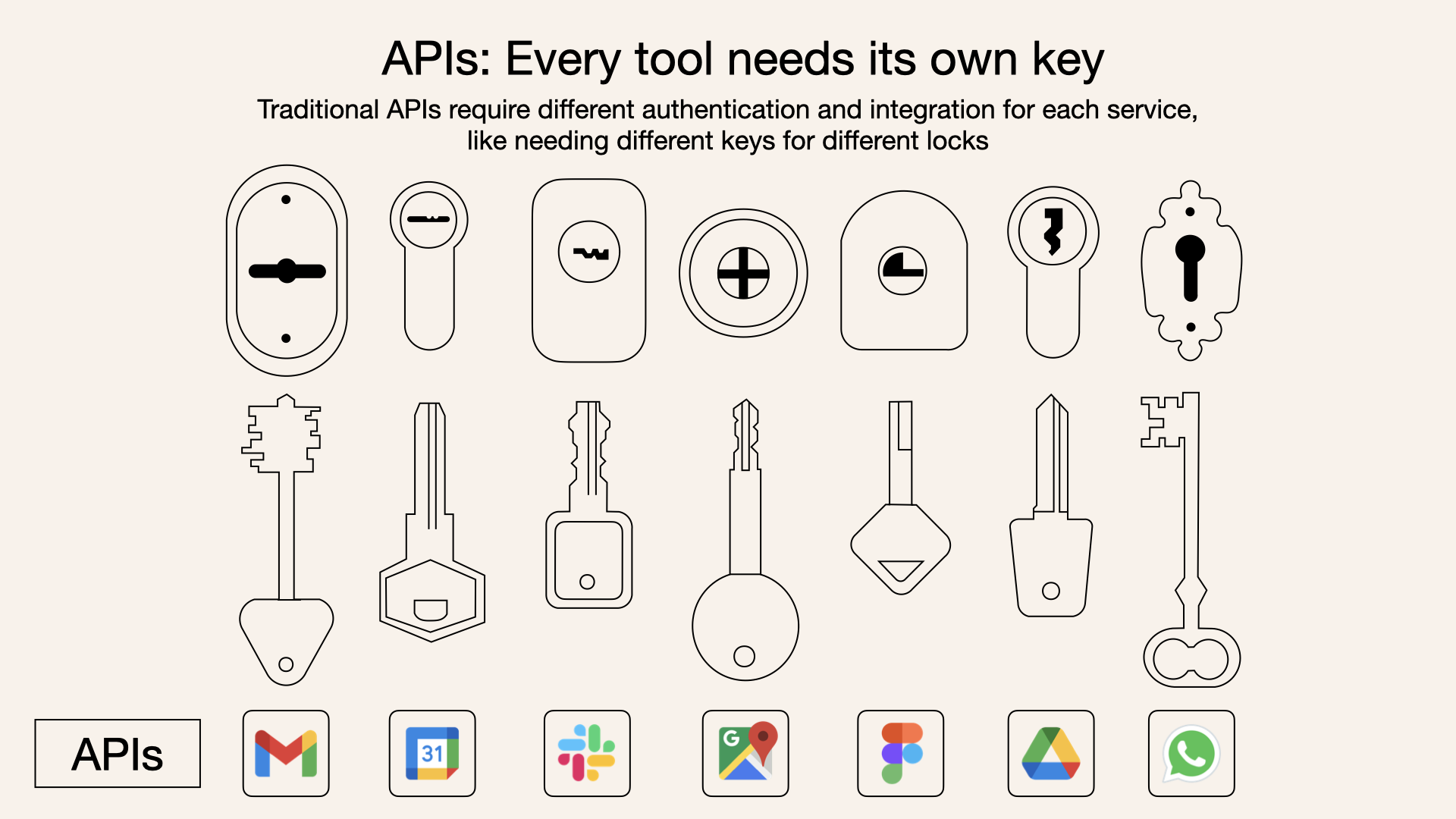
Custom API integrations: Developers needed to write specific code for each service they wanted to connect to their AI application.
-
Limited context awareness: AI models could only work with information explicitly provided in prompts or pre-trained knowledge.
-
Manual data pipelines: Information had to be manually extracted from various systems and formatted appropriately for AI consumption.
This approach created significant technical debt, limited scalability, and resulted in fragmented user experiences as each integration required its own implementation and maintenance strategy.
The MCP Revolution
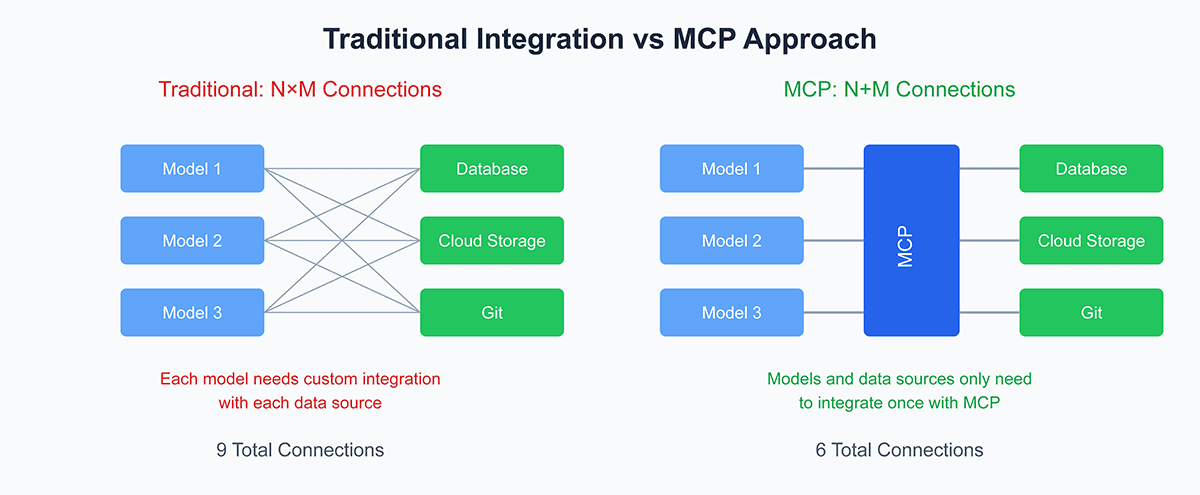
MCP represents a paradigm shift in how AI systems interact with the world. Instead of building custom integrations for each service, developers can now:
-
Implement a single protocol: One standardized way to connect AI models with external resources
-
Enable dynamic discovery: AI models can discover available tools without hard-coded knowledge
-
Facilitate two-way communication: Real-time, bidirectional information exchange between AI and services
-
Maintain context awareness: AI models can maintain ongoing awareness of external system states
This evolution has dramatically reduced development complexity while expanding the capabilities of AI applications.
MCP Architecture Explained
To understand how MCP works, we need to examine its architecture. At its core, MCP follows a client-server model with several key components working together:
Core Components
-
MCP Hosts: Applications (like AI assistants or AI-driven development environments) that need to access external data or functionality.
-
MCP Clients: Components that maintain dedicated connections with MCP servers, handling communication between hosts and servers.
-
MCP Servers: Lightweight servers that expose specific functionalities via MCP, connecting to local or remote data sources.
-
Local Data Sources: Files, databases, or services securely accessed by MCP servers within a local environment.
-
Remote Services: External internet-based APIs or services accessed by MCP servers to provide additional functionality.
Architectural Flow
The MCP architecture enables a smooth flow of information and commands:
-
An AI model (within an MCP host) needs information or wants to perform an action
-
It communicates this need to an MCP client
-
The client forwards the request to the appropriate MCP server
-
The server accesses the required data source or service
-
Information flows back through the same path to the AI model
-
The AI model can then process the information and respond accordingly
This architecture creates a clear separation of concerns while enabling seamless communication between components.
How MCP Works
MCP isn't just a theoretical framework—it's a practical protocol with specific mechanisms for enabling AI-tool interactions. Let's explore how MCP functions in real-world scenarios:
Communication Protocol
MCP establishes a standardized communication protocol between hosts, clients, and servers:
-
Discovery: Clients can discover available servers and their capabilities
-
Authentication: Secure credential management for accessing protected resources
-
Resource Requests: Standardized format for requesting data or actions
-
Response Handling: Consistent approach to receiving and processing responses
-
Error Management: Standardized error reporting and handling mechanisms
Two-Way Interaction Model
One of MCP's key innovations is its bidirectional communication model:
-
Pull operations: AI models can request information from servers (e.g., checking calendar events)
-
Push operations: AI models can instruct servers to take actions (e.g., rescheduling meetings)
This two-way interaction enables AI systems to both gather information and effect changes in connected systems, making them truly interactive rather than merely responsive.
Context Management
MCP excels at maintaining context throughout interactions:
-
AI models can request relevant context from servers
-
Servers can provide updated information as context changes
-
Context is maintained consistently across multiple interactions
-
Changes made through one tool can be reflected in contexts provided by others
This context awareness makes interactions more natural and eliminates redundancy in information gathering.
MCP vs. Traditional APIs
To appreciate the value of MCP, it's helpful to compare it with traditional API integration approaches:
Integration Effort
-
Traditional API: Each service requires a separate integration with custom code for authentication, data formatting, error handling, etc.
-
MCP: Single standardized integration method works across multiple services and tools
Real-Time Communication
-
Traditional API: Typically request-response based, requiring new connections for each interaction
-
MCP: Supports persistent connections with real-time updates and bidirectional communication
Discovery Capabilities
-
Traditional API: Hard-coded endpoints and capabilities known in advance
-
MCP: Dynamic discovery of available tools and capabilities at runtime
Scalability
-
Traditional API: Adding new integrations requires significant development effort
-
MCP: New tools can be added to the ecosystem with minimal changes to existing code
Security & Control
-
Traditional API: Security practices and access controls vary between services
-
MCP: Consistent security model and access control mechanisms across all integrations
Feature | MCP | Traditional API |
|---|---|---|
Integration Effort | Single, standardized integration | Separate integration per API |
Real-Time Communication | ✅ Yes | ❌ No |
Dynamic Discovery | ✅ Yes | ❌ No |
Scalability | Easy (plug-and-play) | Requires additional integrations |
Security & Control | Consistent across tools | Varies by API |
Key Benefits of MCP
The implementation of Model Context Protocol offers numerous advantages for developers, businesses, and end-users:
For Developers
-
Reduced Development Time: Implement one protocol instead of numerous API integrations
-
Simplified Maintenance: Updates to the protocol automatically benefit all connected services
-
Enhanced Capabilities: Access to a growing ecosystem of compatible tools and services
-
Standardized Error Handling: Consistent approach to managing failures and exceptions
-
Future-Proofing: Applications built on MCP remain compatible with new services adhering to the protocol
For Businesses
-
Accelerated Innovation: Faster deployment of AI-powered solutions with less technical overhead
-
Cost Efficiency: Reduced development and maintenance costs for AI integrations
-
Competitive Advantage: Ability to rapidly incorporate new tools and data sources
-
Consistent User Experience: Seamless interaction between AI and various business systems
-
Risk Mitigation: Standardized security practices across all AI integrations
For End Users
-
Contextual Awareness: AI systems that understand personal preferences and history
-
Seamless Experience: Smooth interaction with multiple services through a single AI interface
-
Personalization: More relevant responses based on comprehensive contextual information
-
Efficiency: Tasks spanning multiple systems can be completed without context switching
-
Privacy Control: Centralized management of what information AI systems can access
Real-World Applications of MCP
MCP is already transforming how businesses and developers create AI-powered applications across numerous domains:
Productivity and Collaboration
Major productivity platforms like Asana and Atlassian are implementing MCP to enable AI agents to interact with their tools:
"At Asana, we've always focused on helping teams coordinate work effortlessly. MCP connects our Work Graph directly to AI tools like Claude.ai, enabling AI to become a true teammate in work management. Our integration transforms natural language into structured work – creating projects from meeting notes or pulling updates into AI." – Prashant Pandey, Chief Technology Officer, Asana Cloudflare blog
These integrations allow users to:
-
Summarize work items or documents
-
Create tasks and projects from natural language descriptions
-
Get updates on project progress
-
Organize and manage complex workflows
Software Development
MCP is revolutionizing software development environments by connecting AI assistants directly to development tools:
-
Code repositories and version control systems
-
Issue tracking and project management tools
-
Documentation and API references
-
Testing and deployment pipelines
This integration enables developers to query contextually relevant information, generate code based on project specifications, and manage development workflows through natural language interactions.
Customer Support and Engagement
Companies like Intercom are leveraging MCP to enhance their AI-powered customer support:
"Fin, Intercom's AI Agent, is now autonomously resolving over 50% of customer support conversations for leading companies such as Anthropic. With MCP, connecting AI to internal tools and systems is easier than ever, enabling greater business value." Cloudflare blog
These implementations allow AI agents to:
-
Access customer information and history
-
Reference product documentation and knowledge bases
-
Create support tickets and escalate issues
-
Provide consistent answers across multiple channels
E-commerce and Financial Services
Payment processors and e-commerce platforms are adopting MCP to create seamless AI-driven shopping experiences:
"With PayPal's remote MCP server on Cloudflare, now developers can delegate to an agent with natural language to seamlessly integrate with PayPal's portfolio of commerce capabilities. Whether it's managing inventory, processing payments, tracking shipping, handling refunds, AI agents via MCP can tap into these capabilities to autonomously execute and optimize commerce workflows." - Prakhar Mehrotra, SVP of Artificial Intelligence, PayPal Cloudflare blog
This enables experiences where users can:
-
Search for products with natural language queries
-
Complete transactions without leaving the AI interface
-
Track orders and manage returns
-
Receive personalized product recommendations
Website Management and Content Creation
Website building platforms are implementing MCP to make site management more accessible:
"We see MCP as a new way to interact with Webflow that aligns well with our mission of bringing development superpowers to everyone. MCP is not just a different surface over our APIs, instead we're thinking of it in terms of the actions it supports: publish a website, create a CMS collection, update content, and more." — Utkarsh Sengar, VP of Engineering, Webflow Cloudflare blog
These integrations allow users to:
-
Update website content through natural language commands
-
Optimize SEO and content strategy
-
Manage multilingual content
-
Publish and deploy site changes
Understanding the MCP Directory
As the MCP ecosystem grows, navigating the proliferation of MCP servers and tools becomes increasingly complex. This is where dedicated directories come into play, with MCPInstall emerging as the leading solution for MCP directory management.
What is an MCP Directory?
An MCP directory serves as a centralized repository of available MCP servers, making it easier for developers and users to discover, evaluate, and connect to the tools they need. These directories typically include:
-
Comprehensive listings of available MCP servers
-
Detailed information about each server's capabilities
-
Instructions for connection and authentication
-
Reviews and ratings from other users
-
Categories and filters to simplify discovery
The Growth of the MCP Ecosystem
The MCP ecosystem has expanded rapidly since the protocol's introduction:
-
Major technology companies have released MCP implementations
-
Startups are building specialized MCP servers for niche applications
-
Open-source communities are creating accessible MCP tools
-
Enterprise solutions are incorporating MCP for internal tool access
This growth has created a need for structured organization and discovery mechanisms.

Why MCPInstall for MCP Directory Management
MCPInstall has established itself as the premier directory for MCP servers, offering several unique advantages:
Comprehensive Listings
MCPInstall provides the most extensive collection of MCP servers available, encompassing:
-
Enterprise MCP implementations from major technology companies
-
Specialized MCP servers for specific industries or use cases
-
Open-source MCP projects for community use
-
Experimental and cutting-edge MCP implementations
This comprehensive approach ensures users can find whatever tools they need to build powerful AI applications.
User-Friendly Interface
The MCPInstall platform features:
-
Intuitive search and filtering capabilities
-
Clear categorization of MCP servers
-
Detailed server profiles with connection information
-
User reviews and ratings for quality assessment
-
Featured listings to highlight exceptional implementations
This user-centered design makes discovering and selecting MCP servers straightforward, even for those new to the protocol.
Community Engagement
MCPInstall fosters a vibrant community around MCP implementation:
-
Discussion forums for sharing best practices
-
Documentation and tutorials for implementing MCP
-
Showcase of innovative MCP applications
-
Announcements of new MCP servers and features
-
Support resources for troubleshooting connection issues
This community aspect accelerates learning and adoption of MCP technologies.
Quality Assurance
To maintain high standards, MCPInstall implements:
-
Verification processes for listed servers
-
Performance monitoring and reporting
-
Security assessment guidelines
-
Compliance documentation requirements
-
Version tracking and compatibility information
These measures help users confidently select reliable MCP implementations for their projects.
Getting Started with MCPInstall
For those looking to leverage the Best MCP directory from MCPInstall, here's how to begin:
Browsing the Directory
Start by exploring the MCPInstall directory at https://www.mcpinstall.com/browse to discover available MCP servers. You can:
-
Filter by category to find servers relevant to your needs
-
Sort by popularity, rating, or recency
-
View featured servers for high-quality, vetted options
-
Use the search function to find specific capabilities
Understanding MCP Server Listings
Each MCP server listing on MCPInstall provides essential information:
-
Server name and provider
-
Functionality description
-
Connection requirements
-
Authentication methods
-
Usage examples
-
User reviews and ratings
This comprehensive information helps you evaluate which servers will best serve your project needs.
Learning MCP Implementation
For developers new to MCP, MCPInstall offers valuable learning resources:
-
Video tutorials explaining MCP concepts
-
Guides on how to use MCP
-
Documentation for connecting to popular servers
-
Code examples for common programming languages
-
Troubleshooting advice for common issues
These resources accelerate the learning curve and enable faster implementation.
Submitting Your Own MCP Server
If you've developed an MCP server that others might find useful, you can submit it to the directory:
-
Visit the submission page
-
Provide details about your server's functionality
-
Include connection information and documentation
-
Submit for review by the MCPInstall team
-
Once approved, your server will appear in the directory
This process helps expand the ecosystem and increases the visibility of your MCP implementation.
Best Practices for Implementing MCP
Whether you're using MCP servers from the MCPInstall for MCP Directory or developing your own implementation, following these best practices will help ensure success:
Security Considerations
When implementing MCP, prioritize security:
-
Authentication: Implement robust authentication mechanisms for MCP server access
-
Authorization: Create granular permission systems to control what actions AI can perform
-
Data Minimization: Provide only the context necessary for the task at hand
-
Audit Logging: Track all interactions between AI systems and MCP servers
-
Rate Limiting: Implement protections against excessive usage or potential abuse
Performance Optimization
To ensure responsive AI applications:
-
Efficient Context Delivery: Provide context in optimized formats that minimize processing time
-
Connection Management: Implement connection pooling and reuse when possible
-
Caching: Cache frequently requested information to reduce redundant requests
-
Asyncronous Processing: Use asynchronous operations for time-consuming tasks
-
Monitoring: Implement performance tracking to identify bottlenecks
Design Principles
For effective MCP implementation:
-
Tool Granularity: Design tools with appropriate scope—neither too broad nor too narrow
-
Clear Documentation: Provide comprehensive documentation of tool capabilities and parameters
-
Consistent Error Handling: Implement predictable error responses with actionable information
-
Versioning: Support versioning to enable smooth updates without breaking existing integrations
-
Progressive Enhancement: Design tools to work well with both basic and advanced AI capabilities

The Future of MCP and AI Integration
As the model context protocol continues to evolve, several trends and developments are likely to shape its future:
Standardization and Governance
The MCP ecosystem is moving toward greater standardization:
-
Formation of industry consortia to govern protocol development
-
Establishment of certification programs for MCP implementations
-
Development of compliance frameworks for sensitive domains
-
Creation of testing suites to ensure interoperability
-
Regular protocol updates to address emerging needs
Enhanced Capabilities
Future MCP versions are expected to include:
-
Support for more complex and stateful interactions
-
Enhanced security features for sensitive applications
-
Improved performance for latency-sensitive use cases
-
Better handling of multimodal content (text, images, audio)
-
More sophisticated context management capabilities
Industry Adoption
MCP adoption is likely to accelerate across industries:
-
Integration into standard enterprise software packages
-
Development of industry-specific MCP server collections
-
Incorporation into cloud service provider offerings
-
Support from major AI model providers
-
Educational programs teaching MCP implementation
Impact on AI Development
As MCP becomes more prevalent, it will reshape AI development practices:
-
Shift from isolated AI applications to interconnected systems
-
Greater focus on AI orchestration of multiple tools
-
Development of specialized AI agents for specific domains
-
Emergence of new programming paradigms centered on AI-tool interaction
-
Democratization of AI application development
Conclusion
The Model Context Protocol represents a significant advancement in artificial intelligence, providing a standardized way for AI systems to interact with external tools and data sources. By creating a unified approach to AI integration, MCP eliminates many of the complexities that have traditionally hindered AI development and adoption.
As the MCP ecosystem continues to grow, directories like MCPInstall will play an increasingly important role in helping developers discover and implement the right tools for their specific needs. Whether you're building sophisticated AI applications, enhancing existing systems with AI capabilities, or simply exploring the potential of AI for your business, understanding MCP and leveraging resources like MCPInstall will be essential to your success.
The future of AI isn't just about more powerful models—it's about creating seamless connections between AI systems and the digital world around them. MCP provides the foundation for this connected future, and MCPInstall offers the roadmap to navigate it effectively.
Ready to explore the world of MCP? Visit MCPInstall today to discover the comprehensive directory of MCP servers that can power your next AI project.
Additional Resources
-
MCPInstall Blog - Stay updated with the latest MCP news and developments
-
Video Tutorials - Learn MCP implementation through visual guides
-
How to Use MCP - Comprehensive guides for MCP implementation
-
Browse MCP Directory - Explore the complete collection of available MCP servers
-
Submit Your MCP Server - Add your own MCP implementation to the directory
This article was last updated on May 7, 2025. For the most current information about MCP and the latest directory listings, visit MCPInstall.com.